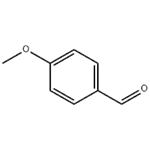
p-Anisaldehyde, also known as anisaldehyde or 4-methoxybenzaldehyde, is a colorless to light yellow liquid at room temperature. It has an odor that is similar to hawthorn. It is insoluble in water, with a solubility of only 0.3%, but it is slightly soluble in propylene glycol and glycerol. It is easily soluble in ethanol, ethyl ether, acetone, chloroform, and most organic solvents. Anisicaldehyde can also be volatilized with water vapor. Anisicaldehyde occurs naturally in fennel oil, cumin oil, dill oil, acacia flowers, and balsam pear extract. It is obtained through oxidation separation and extraction processes. This compound is commonly used as a fragrance base for hawthorn, sunflower, lilac, and other scents. It is also used as a blending spice for scents like freshly cut grass, silver and white acacia flowers, acacia, and balsam grass. Additionally, anisicaldehyde serves as an auxiliary agent for lily of the valley fragrance and a modifier for osmanthus fragrance.
Colorless or light yellow liquid ; Cured getting cold. The relative density : 1.119-1.123, the refractive index: 1.5710-1.5750; boiling point: 246-248℃; melting point: 1-2.5℃; flash point 100℃above. Dissolved in 2 volumes of 60% ethanol. Mutually dissolvable with oil flavor. Acid value < 6.0 .The scent of the flower is like the Hawthorn flower, while the scent of the beans is like the scent of vanilla bean. It has some sweetness of herbs and spices. The fragrance is strong, and lasts for quite long time.
There is a strong anise-like aroma and hawthorn. It is fresh, green fennel aroma. The scent of the flower is like the Hawthorn flower, while the scent of the beans is like the scent of vanilla bean. It has some sweetness of herbs and spices. The fragrance is strong, and lasts for quite long time. There is stronger and clearer alcohol and rougher than anise.
The above information is edited by the Chemicalbook of Tian Ye.
p-Anisaldehyde is the main body of floral perfumes for the deployment of Hawthorn. It can also be used for lilac, orchid, sunflower, acacia, shy flower, black locust, magnolia, wallflowers and sweet bean curd and other floral and new treasure, Hong Wei, aldehyde and other non-fragrant flower essences. It can also be used for other heavy woody sandalwood flavor as well as used in soap flavor. Its sweetness is used in the food and to reconcile flavor.
p-Anisaldehyde has a persistent aroma of hawthorn. It is used as the main spice in hawthorn flowers, sunflower, lilac flavor; Lily of the valley as a flavoring agent in flavor; it can also be used as modifier in the sweet-scented osmanthus flavor as well as for daily flavors and food flavor. The product is allowed for the temporary use of edible spices under China GB2760-86 provisions. It is mainly used for mint flavor of preparation of vanilla, incense and spice, apricot, cream, fennel, caramel, cherry, chocolate, walnuts, raspberry, strawberry, etc. The effect is very good when cooperating with the orange essential oil. As an excellent bright agent for non-cyanide zinc plating DE additive, it can improve the anodic polarization over a wide current range, get bright coating, to create favorable conditions for environmental protection. Anti-microbial drugs cefadroxil benzyl penicillin derived from anisaldehyde in the pharmaceutical industry for the manufacture is an intermediate of antihistamine drugs.
It can be used for the preparation and organic synthesis of perfume.
0.8g of anisaldehyde is accurately weighed, and determined according to the method of aldehyde and ketone determination (OT-7) or the method of determination of two or aldehyde (OT-6).The time of the reactional placement for samples and control samples are 1.5 minutes respectively. Calculation of the equivalent factor (E) is to take 68.08. Or it can be measured by gas chromatography (GT-10-4) nonpolar column method.
LD50 orally in rats: 1510 mg/kg (Jenner)
FEMA (mg/kg): Soft drinks 6.3; cold drink 5.6; candy 14; baked goods 16; puddings class from 0.5 to 30; gum from 18 to 76.Moderate limit(FDA§172.515,2000).The concentration of the final product is generally 5~30mg/kg.
It can be obtained through p-cresol methyl ether from the p-cresol by methylation and then oxidation by adding manganese dioxide and sulfuric acid. Or it is derived from the oxidation of anisole.
Anise aldehyde is mainly included in anise oil, fennel oil, dill oil, gold Albizia julibrissin oil, vanilla extract, etc. When extracted from natural raw materials, it is oxidated by ozone, nitric acid, potassium permanganate, sodium dichromate or sulfuric acid, in the presence of p-Aminobenzene Sulfonic. It can also be obtained as follows: Anethole is Isolated from the essential oil, then decomposed by yellow blood salt, water, sodium bisulfite and other appropriate decomposing agent, cutting off the allyl double bond and generating anise aldehyde. According to the method, the yield was 60%. It had been discovered and synthesized before it has been isolated from the essential oil. The product can be prepared to take from phenol and anisole, cresol ether, preparation of p-hydroxybenzaldehyde and other raw materials. Using dimethyl sulfate for methylation of phenol, followed by chloromethylation reaction Fennel introducing chloromethyl ether and Urotropine with salt, and then hydrolyzed to chloromethyl into aldehyde (Suo Mulai reaction) to prepare p-methoxy benzaldehyde. Another promising approach is to turn on the methylation of toluene, the formation of methyl phenyl ether, and then oxidation to obtain the production. In foreign countries, the current method is using oxidating p-methyl anisole in sulfuric acid in the presence of the oxidizing agent such as potassium dichromate, potassium permanganate and manganese dioxide.
p-Methoxybenzaldehyde has a characteristic hawthorne odor and
a pungent, anise-like flavor. It has a bitter flavor above 30 - 40 ppm.
May be prepared by methylation and oxidation of p-cresol and
also by oxidation of anethole.
p-Anisaldehyde is a colorless to slightly yellowish liquid with a sweet, mimosa, hawthorn odor. It occurs in many essential oils, often together with anethole. It can be hydrogenated to anise alcohol and readily oxidizes to anisic acid when exposed to air. It is miscible in alcohol, ether, and most fixed oils, soluble in propylene glycol, insoluble in glycerin, water, and mineral oil.
Reported found in essential oils and extracts of vanilla, Acacia farmesiana Willd., Magnoila salicifolia
Maxim., Erica arborea, Pirus communis, Boswellia serrata, and others; also in anise, fennel and star anise (especially when aged
due to the oxidation of anethole), cranberry, black currant, cinnamon and basil.
Perfumery and toilet soaps; odor resembles that of coumarin, but the aldehyde must be mixed with other odorous substances to yield an agreeable odor. Also used in organic syntheses.
4-Methoxybenzaldehyde is widely utilized in the fragrance and flavor industry. It finds application as an important intermediate in the synthesis of other organic compounds, perfumes and pharmaceuticals like antihistamines. It is also used in the preparation of agrochemicals, dyes and plastic additives. A solution of para-anisaldehyde with acid and ethanol is used as stain in thin layer chromatography (TLC), which provides easy identification of different compounds. Concentrations usually 0.5 to 30 ppm in
finished goods, and up to 75 ppm in chewing
gum. The flavor threshold for Anisaldehyde
on the average panel person is about 0.2 ppm.
(Single chemical in Sugar water).
ChEBI: P-methoxybenzaldehyde is a member of the class of benzaldehydes consisting of benzaldehyde itself carrying a methoxy substituent at position 4. It has a role as an insect repellent, a human urinary metabolite, a plant metabolite and a bacterial metabolite.
By methylation and oxidation of p-cresol and also by oxidation of anethole.
Aroma characteristics at 1.0%: sweet powdery, spicy creamy, fruity, vanilla and hay-like. Coumarin,
almond, anisic with berry nuances.
Taste characteristics at 5 to 10 ppm: sweet powdery, vanilla creamy, spice anise, nutty, cherry pit and
almond-like nuances.
p-anisaldehyde is an aromatic aldehyde commonly found in anise seed oil. It shows acaricidal activity and is primarily used, as a lead compound for the development of new agents for the selective control of house dust mites.
Flammability and Explosibility
Non flammable
Moderately toxic by
ingestion. A skin irritant. Mutation data
reported. Combustible liquid. When heated
to decomposition it emits acrid smoke and
irritating fumes
Anisic aldehyde undergoes a very slight degree of demethylation with oxi�dation of its aldehyde group to an acid group, the major metabolite excreted being anisic
acid (Williams, 1959).
Wash the aldehyde with saturated aqueous NaHCO3, then H2O, steam distil, extract the distillate with Et2O, dry (MgSO4) the extract, filter and distil this under a vacuum and N2. Store it in glass ampules under N2 in the dark. [Beilstein 8 IV 252.]