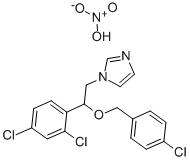
In a 500mL four-necked reaction flask equipped with a mechanical stirrer and reflux condenser, add 51.4g imidazole ethanol, 35g anhydrous potassium carbonate, 105g isopropanol I, 1.5g TBAB, and 3.5g BF4. Heat under reflux for 1 hour, cool to 75℃, add 34g p-chlorobenzyl chloride, and react at 72±1℃ for 4.0 hours. Filter, recover isopropanol by vacuum distillation, add 160g toluene and 20% NaOH solution, stir, wash with water until neutral, and distill the supernatant under vacuum to obtain free alkaline oil. Dissolve in 140g isopropanol II, and acidify with 18g of 68% concentrated nitric acid and 23g of water to prepare 30% dilute nitric acid until precipitation stops. Filter, wash with water, and dry to obtain crude econazole nitrate.
The crude econazole nitrate and 230g of 95% ethanol were added to a 500mL four-necked reaction flask equipped with a mechanical stirrer and a reflux condenser. The mixture was stirred and heated until the crude econazole nitrate was completely dissolved. After slightly cooling, an appropriate amount of activated carbon was added, and the mixture was refluxed for 30 minutes. The mixture was then hot-filtered, allowed to cool naturally to room temperature, and then cooled to 5°C in an ice-water mixture. White crystals precipitated. These were filtered, and the filter cake was dried at 60°C to constant weight, yielding 72.5g of econazole nitrate, with a yield of 81.6%, a melting point of 164.2–164.9°C, and a purity of 99.95%.
Econazole nitrate is the nitrate salt form of Econazole. It belongs to imidazole-class antifungal medication sold in various places around the world including US, Canada, Western Europe, and Asia. It is usually manufactured into cream form for sale. Econazole nitrate is mainly used for the treatment of skin infections including athlete's foot, tinea, pityriasis versicolor, ringworm, and jock itch caused by fungi such as Trichophyton rubrum, Trichophyton tonsurans and Microsporum audouini. As an imidazole-class drug, Econazole nitrate takes effects through inhibiting the biosynthesis of ergosterol, a key component of fungal cell membrane, thus disrupting the normal permeability of fungal membrane. This causes leakage of essential cellular contents of fungi, further killing them.
http://www.rxlist.com/econazole-nitrate-cream-drug/clinical-pharmacology.htm
https://en.wikipedia.org/wiki/Econazole
http://www.pdr.net/drug-summary/Econazole-Nitrate-econazole-nitrate-731
Pevaryl,Cilag Chemie,France,1976
Antifungal;Ergosterol synthesis inhibition
Econazole nitrate is an antifungal agent of the imidazole type used in topical and vaginal preparations to prevent growth of dermatophytes, yeast, and mold.
A suspension of 10.3 parts of α-(2,4-dichlorophenyl)-imidazole-1-ethanol and
2.1 parts of sodium hydride in 50 parts of dry tetrahydrofuran is stirred andrefluxed for 2 hours. After this reaction-time, the evolution of hydrogen is
ceased. Then there are added successively 60 parts dimethylformamide and 8
parts of p-chlorobenzylchloride and stirring and refluxing is continued for
another two hours. The tetrahydrofuran is removed at atmospheric pressure.
The dimethylformamide solution is poured onto water. The product, 1-[2,4-
dichloro-β-(p-chlorobenzyloxy)phenethyl]imidazole, is extracted with benzene.
The extract is washed with water, dried, filtered and evaporated in vacuo.
From the residual oily free base, the nitrate salt is prepared in the usual
manner in 2-propanol by treatment with concentrated nitric acid, yielding,
after recrystallization of the crude solid salt from a mixture of 2-propanol,
methanol and diisopropylether, 1-[2,4-dichloro-β-(p�chlorobenzyloxy)phenethyl]imidazole nitrate; MP 162°C.
Spectazole (Johnson & Johnson).
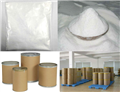
White crystalline powder.
Flash point data for Econazole nitrate are not available; however, Econazole nitrate is probably combustible.
Econazole interacts with 14-α demethylase, a cytochrome P-450 enzyme necessary to convert lanosterol to ergosterol. Inhibition of ergosterol results in increased cellular permeability causing leakage of cellular contents. Econazole may also inhibit endogenous respiration, interact with membrane phospholipids, inhibit the transformation of yeasts to mycelial forms, inhibit purine uptake, and impair triglyceride and phospholipid biosynthesis.