

Chemical Properties
| Melting point | −210 °C(lit.) |
| Boiling point | −196 °C(lit.) |
| Density | 1.2506 |
| vapor density | 0.97 (vs air) |
| solubility | At 20 °C and at a pressure of 101 kPa, 1 volume dissolves in about 62 volumes of water and about 10 volumes of ethanol (96 per cent). |
| form | colorless gas |
| color | colorless |
| Odor | odorless, tasteless |
| Water Solubility | slightly soluble H2O; insoluble alcohol [HAW93] |
| Thermal Conductivity | 0.02583 W/(m·K) |
| Specific Heat Capacity | Cp(gas): 1.04 J/(g·K), at 25℃ |
| Merck | 13,6634 |
| Henry's Law Constant | 6.4×10⁻⁶ mol/(m3Pa) at 25℃, Burkholder et al. (2019) |
| Dielectric constant | 1.0(20℃) |
| Cosmetics Ingredients Functions | PROPELLANT |
| InChI | 1S/N2/c1-2 |
| InChIKey | IJGRMHOSHXDMSA-UHFFFAOYSA-N |
| SMILES | N#N |
| Surface tension | 5.13 mN/m at 95K,0.540MPa |
| CAS DataBase Reference | 7727-37-9(CAS DataBase Reference) |
| NIST Chemistry Reference | Nitrogen(7727-37-9) |
| EPA Substance Registry System | Nitrogen (7727-37-9) |
Safety Information
| Safety Statements | 38 |
| RIDADR | UN 1066 2.2 (NITROGEN, COMPRESSED) |
| RIDADR | UN 1977 2.2 (NITROGEN, REFRIGERATED LIQUID) |
| WGK Germany | - |
| RTECS | QW9700000 |
| F | 4.5-31 |
| TSCA | TSCA listed |
| DOT Classification | 2.2 (Nonflammable gas) |
| HazardClass | 2.2 |
| Storage Class | 2A - Gases |
| Hazard Classifications | Press. Gas Compr. Gas |
| Hazardous Substances Data | 7727-37-9(Hazardous Substances Data) |
MSDS
| Provider | Language |
|---|---|
| Nitrogen | English |
| SigmaAldrich | English |
Usage And Synthesis
In the food industry nitrogen is used to prevent mold growth, spoilage from oxidation, and insect infestation.
Other miscellaneous applications of nitrogen gas include pressurizing cable jackets, preventing carburization in welding and soldering, inflating balloons, agitating liquid baths, and cooling catalytic reactors in petroleum refining.
Nitrogen has many commercial and technical applications. As a gas, it is used in heat treating of primary metals; blanketing of oxygen- sensitive liquids and of volatile liquid chemicals; the production of semiconductor electronic components, as a blanketing atmosphere; the blowing of foam-type plastics; the deaeration of oxygen-sensitive liquids; the degassing of nonferrous metals; food processing and packing; inhibition of aerobic bacteria growth; magnesium reduction of aluminum scrap; and the propulsion of liquids through pipelines.
Gaseous nitrogen is also used in pressurizing aircraft tires and emergency bottles to operate landing gear; purging, in the brazing of copper tubing for air-conditioning and refrigeration systems; the purging and filling of electronic devices; the purging, filling, and testing of high-voltage compression cables; the purging and testing of pipelines and related instruments; and the treatment of alkyd resins in the paint industry.
Liquid nitrogen also has a great many uses, among them the freezing of highly perishable foods such as shrimp, hamburgers, and chicken; deflashing of rubber tires; cooling of concrete; and the cold-trapping of materials such as carbon dioxide from gas streams (commonly used in this way in systems that produce high vacuums). It is used as a coolant for electronic equipment, for pulverizing plastics, and for simulating the conditions of outer space. Other ways in which liquid nitrogen is used include: creating a very high pressure gaseous nitrogen (15 000 psig or 103 000 kPa) through liquid nitrogen pumping; in food and chemical pulverization; for the freezing of liquids in pipelines for emergency repairs; for low temperature stabilization and hardening of metals; for low temperature research; for low temperature stress relieving of aluminum alloys; for the preservation of whole blood, livestock sperm, and other biologicals; for refrigerating foods in local and long-distance hauling; for refrigeration shielding of liquid hydrogen, helium, and neon; for the removal of skin blemishes in dermatology; and for shrink fitting of metal parts.
Liquid nitrogen also has a number of classified applications in the missile and space programs of the United States, in which it is used in large quantities.
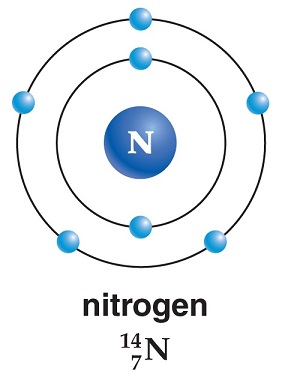
There is a balance of nitrogen with other gases in the atmosphere that is maintained bywhat is called the nitrogen cycle. This cycle includes several processes, including nitrogen fixationof bacteria in the soil by legumes (bean and pea plants). Lightning produces nitrogen, asdo industrial waste gases and the decomposition products of organic material (i.e., organicproteins and amino acids in plants and animals contain nitrogen). In time, these sourcesreplace the nitrogen in the atmosphere to complete the cycle.
Ammonia (NH3) is the first binary molecule discovered in outer space of our galaxy, theMilky Way. It may also be the main compound that forms the rings of the planet Saturn.
Although nitrogen is considered an inert element, it forms some compounds that are veryactive. Of the diatomic molecules, such as CO2 , it is difficult to separate the two atoms innitrogen’s molecules because of their strong binding energy. This is the reason that, along withcarbon dioxide, nitrogen gas is stable. However, once separated, the individual atoms of nitrogen(N) become very reactive and do combine with hundreds of other elements.
Nitrogen can be liquefied easily, making it useful in many applications wherein sustainedcooling is needed. At high temperatures, nitrogen reacts with many metals to form nitrides.
When recovered as a gas in the atmosphere, it is used to produce anhydrous ammonia(NH3), which is the fifth most commonly produced chemical in the United States. It is alsoused as the basis for making many nitrogen compounds. At one time it was believed to beimpossible to combine hydrogen with nitrogen to form ammonia, a natural product of animalwaste that was used as a fertilizer and textile bleach, among other things.
Nitric acid (HNO3) is an important commercial chemical and was manufactured commerciallyto produce fertilizers and explosives as well as plastics and many other products. In1902 a German chemist, Wilhelm Ostwald (1853–1932), developed a process wherein at hightemperatures he used platinum catalysts to convert ammonia into nitric acid. When nitric acidis reacted with glycerol, the result is nitroglycerine—an unstable explosive unless dissolved ininert material, such as clay. It can then be stabilized as dynamite.
Nitrogen oxides are formed under certain conditions when nitrogen combines with oxygen,thus contributing to pollution. One source is from the internal combustion engine thatproduces NO similar to lightning. Once released, it combines with more oxygen to form ,which is a very reactive polluting gas. Nitrogen dioxide NO2 is the main cause of “brown”smog over some cities and is harmful to plants, animals, and humans. To make matter worse,if there is adequate sunlight at the time of the smog, the ultraviolet light of the sun will breakdown the N and O of the NO2 to form free radicals of oxygen that are reactive, forming ozone(O3), which is itself a strong oxidizing agent that adds to pollution.
Several of the oxygen, hydrogen, and halogen compounds of nitrogen are toxic wheninhaled. A common error made in using household cleaners is to mix or use together ammoniacleaning fluids (containing nitrogen) and Clorox-type cleaning fluids (containing chlorine).The combined fumes can be deadly in any confined area. NEVER mix Clorox with ammoniatypecleaning fluids.
Nitrogen in adequate quantity often leads to the desirable thin cell walls and leads to more tender and succulent plants, resulting into a better crop yield. Nitrogen is absorbed by plants either in the cationic or the anionic form as ammonium ion (NH4+ ) or nitrate ion (NO3 - ). These ions are soluble in water and are, therefore, very easily leached. If fertilizer is applied when it rains, obviously a lot of it will be washed away, and in this way, the annual nitrogen loss can be as much as 50 to 80 kg/ha.
Nitrogen loss occurs through leaching, volatilization, immobilization and ammonium faation. Denitrification or conversion of nitrate to nitrogen gas by bacteria is another cause for extensive loss of gaseous nitrogen. Ammonium ions in a basic solution leads to ammonia loss by volatilization. Surface applications of any ammonium or urea fertilizer on calcareous soils cause the largest ammonia losses.
The mineralized ammonium ions have a very short life, whereas the nitrification process is rapid. So, slowing down of the oxidation of ammonium ions to the nitrate form reduces the nitrate (and nitrogen) loss by leaching or denitrification. Several nitrification inhibitors such as nitrapyrin and dicyandiamide (DCD) are used to inhibit nitrification.
Nitrogen furaton provides a major source of soil nitrogen. Nitrogen fixation involves the action of microbes that convert the relatively inert nitrogen of the soil air into such forms as are useful to plants. The natural biological and chemical processes through which inorganic and organic nitrogen are inter-converted, are collectively known as the nitrogen cycle. It includes ammonification, ammonia assimilation, nitrification, nitrate assimilation, nitrogen fixation and denitrification.
Materials supplying nitrogen are (a) anhydrous ammonia (NH3) which is hazardous and difficult to handle, (b) urea [CO(NH2)2] which is a good, cheap and the most popular fertilizer, (c) ammonium nitrate (NH4NO3) which is a relatively cheap source of solid nitrogen fertilizer, and (d) ammonium sulphate [(NH4)2SO4] which is not as popular as urea and ammonium nitrate.
Since fertilizer nitrogen efficiency is determined by the biomass yield and nitrogen uptake by the crop, all factors affecting these also affect the efficiency of nitrogen usage. These factors are classified into five groups such as the soil, crop, environment, agronomic practices and fertilizer management.
Nitrogen deficiency symptoms are most prevalent and the easiest to identify. Young plants exhibit yellowish green foliage and stunted growth while older plants show yellowing or falling of leaves.
Nitrogen deficiency impedes good yield. An effective, integrated approach employs organic manures, biofertilizers, chemical fertilizers, nitrification inhibitors, coated and long-persisting nitrogen fertilizers. Such practices hold the key to sustainable agriculture. Nitrogen is used in the production of ammonia, acrylonitrile, nitrates, cyanamide, cyanides and nitrides. It is used in the manufacture of explosives and as an inert gas for purging. It is also used in cryogenic preservation, as a source of pressure in oil wells, inflating tires and as a component of fertilizer mixtures. However, overuse of nitrogen fertilizers is responsible for increased quantities of nitrates in the soil water, posing a serious threat to the environment.
Advantages of compressed gases as aerosol propellants are that they are less expensive; of low toxicity; and practically odorless and tasteless. In contrast to liquefied gases, their pressures change relatively little with temperature. However, there is no reservoir of propellant in the aerosol and as a result the pressure decreases as the product is used, changing the spray characteristics.
Misuse of a product by the consumer, such as using a product inverted, results in the discharge of the vapor phase instead of the liquid phase. Most of the propellant is contained in the vapor phase and therefore some of the propellant will be lost and the spray characteristics will be altered. Additionally, the sprays produced using compressed gases are very wet. However, recent developments in valve technology have reduced the risk of misuse by making available valves which will spray only the product (not propellant) regardless of the position of the container. Additionally, barrier systems will also prevent loss of propellant, and have been used for pharmaceuticals and cosmetic aerosol sprays and foams utilizing nitrogen as the propellant.
Nitrogen is also used to displace air from solutions subject to oxidation, by sparging, and to replace air in the headspace above products in their final packaging, e.g. in parenteral products packaged in glass ampoules. Nitrogen is also used for the same purpose in many food products.
Because of the importance of nitrogen compounds in agriculture and chemical industry, much of the industrial interest in elementary nitrogen has been in processes for converting elemental nitrogen into nitrogen compounds. The principal methods for doing this are the direct synthesis of ammonia from nitrogen and hydrogen, the electric arc process, which involves the direct combination ofN2 and O2 to nitric oxide, and the cyanamide process.
Death may result from errors in judgment, confusion, or loss of consciousness, which prevents self-rescue. At low-oxygen concentrations, unconsciousness and death may occur in seconds without warning.
Gaseous nitrogen must be handled with all the precautions necessary for safety with any nonflammable, nontoxic compressed gas.
All precautions necessary for the safe handling of any gas liquefied at very low temperatures must be observed with liquid nitrogen. Extensive tissue damage or burns can result from exposure to liquid nitrogen or cold nitrogen vapors.
Preparation Products And Raw materials
- Ethyl benzoylformate2-Furanboronic acidDicyclohexylphenylphosphineEthyl thiophene-3-carboxylateQuinoline-5-boronic acidDiethylphenylphosphine2-Isopropylphenylboronic acidtri-isopropanlamiue polyoxypropyleal polyoxy-ethylene etherIrinotecanPPVEthyl 2-(1-methyl-1H-imidazol-2-yl)-2-oxoacetateEthyl 4-hydroxy-7-(trifluoromethyl)quinoline-3-carboxylate6-Methylpyridine-3-boronic AcidCalcium nitrite2-Fluoro-3-pyridylboronic acid4-Cyanophenylboronic acid3-Chlorothiophene-2-carboxylic acid2-(Trifluormethoxy)phenylboronic acid2-Fluoropyridine-6-carboxylic acid2-Ethoxyphenylboronic acidhydrogen [4-[[4-(diethylamino)phenyl][4-[ethyl[(3-sulphonatobenzyl)amino]-o-tolyl]methylene]-3-methylcyclohexa-2,5-dien-1-ylidene](ethyl)(3-sulphonatobenzyl)ammonium, sodium saltan improved PVA hydrogel as artificial vitreous bodytransfer factor (TF)Thienamycinsoftening agent SCI-Apesticide emulsifier 602^<#^>Propyl isocyanateoctyl phenyl polyoxyethylene (30) etherEmulsifier LAE-9Calcium nitrate tetrahydrateIsopropyl(4-chlorophenyl)acetyl chloride2-Amino-4,4'-dichlorodiphenyl etherFerric nitrate nonahydrateC^{8~9^} alkyl phenyl polyoxyethylene (15) etherAluminum nitride3,4-Diethoxyanilinepare isopropyl phenol polyoxyethylene (9~10) etherpolyoxyethylene polyoxypropylene monobutyl etherdacron oiling agent 99^<#^>AE series crude oil viscosity reducer
Nitrogen manufacturers
Related articles
What is nitrogen used for?May 24,2024
Fun facts about nitrogenMar 11,2024
Does nitrogen have a 2 charge?Feb 19,2024
Question and answer
Related Product Information
- 5-Mercapto-1-methyltetrazole
- Granisetron hydrochloride
- FAST RED RC SALT
- FAST BLUE B SALT FOR MICROSCOPY
- HATU
- 2,2-Dibromo-2-cyanoacetamide
- Drometrizole
- 2-(5-Mercaptotetrazole-1-yl)ethanol
- Faropenem sodium
- Nessler's Reagent
1of5
The What'sApp is temporarily not supported in mainland China