White To Pale-Yellow Powder
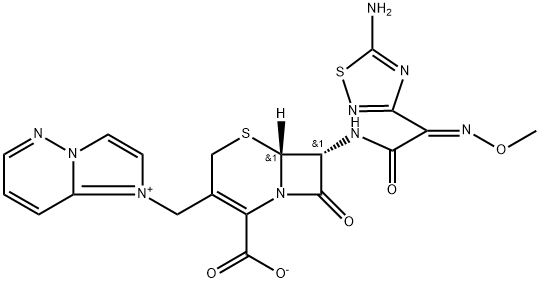
ChEBI: Cefozopran is a fourth-generation cephalosporin antibiotic having imidazo[1,2-b]pyridazin-1-ium-1-ylmethyl and [(2Z)-2-(2-amino-1,3-thiazol-4-yl)-2-(methoxyimino)acetyl]amino side groups located at positions 3 and 7 respectively. It is a cephalosporin, a member of thiadiazoles and an imidazopyridazine.
An aminothiazole cephalosporin formulated as the hydrochloride.
Activity is similar to that of ceftazidime, but it is more
active against methicillin-susceptible staphylococci (MIC 1
mg/L). Representative MICs against Gram-negative species
are: Esch coli 0.25 mg/L; K. pneumoniae 1 mg/L; Ps. aeruginosa
1–8 mg/L. Activity against Acinetobacter spp., Sten. maltophilia
and B. fragilis group is poor.
A 20-min infusion of 1.5 g achieved a plasma concentration
of around 125 mg/L at the end of infusion. Almost 90%
of the dose was excreted in the urine over 24 h. The mean terminal
half-life was around 2 h. Adverse reactions appear to be
typical of those of other group 6 cephalosporins.
It is available in Japan.
Cefozopran (SCE-2787) (5-80 mg/kg; s.c.; twice a day for 5 days; four-week-old ICR male mice) is effective against acute respiratory tract infections caused by Kiebsiella pneumonia DT-S. In the model of chronic respiratory tract infection caused by K. pneumoniae 27, Cefozopran (20-80 mg/kg; s.c.; twice a day for 7 days; five-week-old CBA/J female mice) is as effective as Ceftazidime[2].