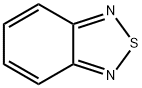
2,1,3-Benzothiadiazole is a chemical reagent used in the synthesis of supramolecules as well as the synthesis of benzothiadiazole derivatives via cross coupling.
The product is used as an industrial solvent, and pharmaceutical intermediates for organic synthesis and used nitrocellulose and other resin, wax, fatty, dyes and other solvents.
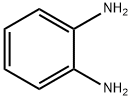
2,1,3-benzothiadiazole undergoes the standard chemistry of aromatic compounds, for example readily forming nitro and chloro derivatives.Under reducing conditions, it can be converted back to the 1,2-diaminobenzene compounds from which they were prepared.
General procedure for the synthesis of 2,1,3-benzothiadiazole from o-phenylenediamine: 1,2-diaminobenzene (3.250 g, 30.05 mmol) and triethylamine (18 mL, 130.0 mmol) were dissolved in dichloromethane (20 mL). A solution of sulfuryl chloride (7.0 mL, 96.00 mmol) in dichloromethane (10 mL) was added dropwise with stirring. After completion of the reaction, the solvent was removed by rotary evaporator and the combined organic layers were concentrated under vacuum to afford the target product 2,1,3-benzothiadiazole (3.956 g, 97% yield). The melting point of the product was 43 °C. 1H NMR (CDCl3, 400 MHz, TMS) δ: 8.04-8.00 (m, 2H), 7.62-7.57 (m, 2H).
[1] Dyes and Pigments, 2016, vol. 124, p. 268 - 276
[2] Chemistry of Heterocyclic Compounds (New York, NY, United States), 1989, vol. 25, # 11, p. 1303 - 1307
[3] Khimiya Geterotsiklicheskikh Soedinenii, 1989, # 11, p. 1555 - 1558
[4] Tetrahedron, 2005, vol. 61, # 46, p. 10975 - 10982
[5] Tetrahedron Letters, 2005, vol. 46, # 40, p. 6843 - 6846