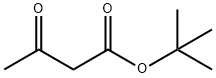
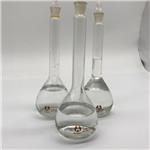
Tert-Butyl acetoacetate is a reagent used to acetoacetylate hydroxyl-bearing coatings resins, such as polyesters, acrylics, cellulosics, and epoxies. It can be used as an acetoacetylating reagent in pharmaceutical, agrichemical, and pigment applications. It is used as an intermediate for the syntheses of different organic chemicals. For instance, it may be used to synthesize various acetoacetic acid derivatives, acetoacetates, acetoacetamides, 1-(diethylamino)-2-acetoacetoxypropane, (S)-tert-butyl 3-hydroxybutyrate, benzothiazole β-keto ester derivatives, and 3,4-disubstituted pyrroles.
Intermediate for the syntheses of different organic chemicals. Product Data Sheet
tert-Butyl acetoacetate is used as intermediate for the syntheses of different organic chemicals. Raw material in pharmaceutical Industry, In agrochemical industry. Reagent for Acyloin synthesis and ,β - unsaturated ketones synthesis.
tert-Butyl acetoacetate (t-BAA) is a cheap and easy to store commercial reagent. Reaction demonstrated that the more hindered tert-butyl acetoacetate (t-BAA, la) is ca.15-20-fold more reactive than the more commonly used methyl or ethyl analogs. It is widely employed as an acetoacetylating reagent.
Flammability and Explosibility
Flammable
β-Actin modulates cell growth, migration and the G-actin pool. Mutations in ACTB leads to pleiotropic developmental disorder.
In the reaction vessel, add tert-butanol and catalyst; said catalyst is selected from fatty amine catalyst or tertiary amine catalyst; or, the catalyst is a fatty amine catalyst and tertiary amine catalyst, catalyst is one or several kinds of arbitrary ratio mixing; heating to 20 ~ 120 , dropwise addition of bis(vinylidene) ketone, the reaction process reaction temperature is controlled in the range of 20 ~ 150 , the end of the dropwise addition, the control of the temperature at The reaction temperature is controlled at 20-150 , the end of dropwise addition, control the temperature at 20-150 holding time of 0.5-8 hours to end, to get the crude tert-butyl acetoacetate ester; said tert-butanol and bis(vinylidene) ketone molar ratio of 1-2:1, the amount of catalyst added for the total amount of 0.1wt% to 2wt%. Using this process to synthesize tert-butyl acetoacetate, the conversion rate of bis(vinyl ketone) reaches 100%, the yield of the finished product reaches more than 94%, and the product content reaches more than 99%.
Distil it under reduced pressure through a short column. [Lawesson et al. Org Synth Coll Vol V 155 1973, Lawesson et al. Org Synth 42 28 1962, Beilstein 3 IV 1536.] HARMFUL VAPOUR.