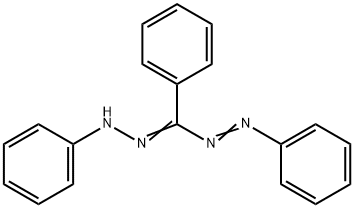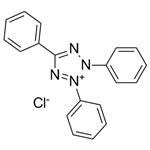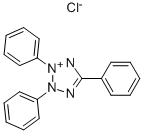
2,3,5-Triphenyltetrazolium chloride
- Product Name2,3,5-Triphenyltetrazolium chloride
- CAS298-96-4
- MFC19H15ClN4
- MW334.8
- EINECS206-071-6
- MOL File298-96-4.mol
Chemical Properties
| Melting point | 250 °C(lit.) |
| Boiling point | 490.96°C (rough estimate) |
| Density | 1.1704 (rough estimate) |
| bulk density | 230kg/m3 |
| refractive index | 1.6110 (estimate) |
| storage temp. | 2-8°C |
| solubility | H2O: may be clear to slightly hazy |
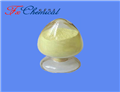
| form | powder |
| color | faint yellow |
| PH | 3.7 (20°C, 10g/L in H2O) |
| Water Solubility | Soluble in water, ethanol and acetone. Insoluble in ether. |
| λmax | 247 nm |
| Sensitive | Light Sensitive & Hygroscopic |
| Merck | 14,9744 |
| BRN | 3923356 |
| Stability | Stable. Light sensitive. Protect from moisture. Incompatible with strong oxidizing agents. |
| Major Application | diagnostic assay manufacturing hematology histology |
| Biological Applications | Algae viability assay; microbial growth assays; transketolase activity screening assays; detecting bacteria,g-hydroxybutyric acid (GHB),microorganisms,myocardial infarction; measuring dehydrogenase activity; treating cancer |
Safety Information
| Hazard Codes | Xi,Xn |
| Risk Statements | 36/37/38-20/21/22 |
| Safety Statements | 26-36 |
| WGK Germany | 3 |
| RTECS | XF8100000 |
| F | 3-8-10 |
| TSCA | TSCA listed |
| HS Code | 29339900 |
| Storage Class | 4.1B - Flammable solid hazardous materials |
| Hazard Classifications | Eye Irrit. 2 Flam. Sol. 1 Skin Irrit. 2 |
| Toxicity | LD50 intravenous in mouse: 5600ug/kg |