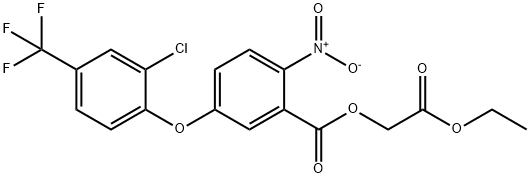
Fluoroglycofen-ethyl is a nitrophenyl ether compound used as a post-emergence herbicide. It has a low aqueous solubility and a low volatility. Under most conditions it tends not to be environmentally persistent. It is moderately toxic to mammals via the oral route. Information on chronic health risks is missing. It is highly toxic to birds and algae but less so to other species.
The commercial production of fluoroglycofen-ethyl involves a carefully controlled chemical synthesis process. It begins by mixing acifluorfen, toluene, and a catalyst, then heating the mixture to initiate the reaction. Potassium carbonate is added next, and the temperature is raised to promote further chemical transformation. Ethyl chloroacetate is then introduced, and the mixture is heated to 90–105 DegC to complete the esterification reaction. Once the reaction concludes, the mixture is slowly cooled and extracted using a toluene-water solution to isolate the organic layer. This layer is then distilled to remove any remaining solvents or impurities, yielding high-purity fluoroglycofen-ethyl.