Acifluorfen is a post-emergence herbicide, usually used as the sodium salt. It is highly soluble in water, with a low vapour pressure and may be moderately persistent in soils and water depending upon conditions. Based on its chemical properties it has a high potential for leaching to groundwater. It has a low to moderate toxicity to most biodiversity. It is not highly toxic to human but is known to be a skin and eye irritant.
A diphenyl ether, is a combustible, off-white, light tan or brown solid.
Acifluorfen is an herbicide against broadleaf weeds. An environmental toxin relating to in vivo toxicity of nitroaromatics.Environmental toxin on US EPA Toxic Release Inventory list (TRI) list.
Acifluorfen is commercially produced through the synthesis of diphenyl ether derivatives, specifically by coupling a substituted nitrophenol with a halogenated benzoic acid derivative. The process typically involves nitration, etherification, and halogenation steps under controlled conditions to form the active herbicidal compound. These reactions require organic solvents, catalysts, and purification stages to ensure product stability and efficacy.
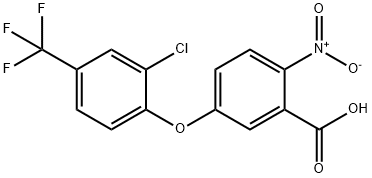
ChEBI: A member of the class of benzoic acids that is 2-nitrobenzoic acid in which the hydrogen at position 5 is replaced by a 2-chloro-4-(trifluoromethyl)phenoxy group. It is a herbicide used for the post-emergence control of a variety of annual broadleaf weeds.
Acifluorfen is a Herbicide: used to control pre-emergent and post-emergent broadleaf weeds and grasses in soybean, peanut, pea and rice crops. It is also registered for use by homeowners as a spot treatment on driveways, sidewalks, and patios. It should not be mixed with oils, surfactants, liquid fertilizers, and other pesticides. Not approved for use in EU countries.
ASIF®; BLAZER®; CARBOFUORFEN®;
KLEENUP® Grass and Weed Killer; RH-6201; SCEPTER
O.T. HERBICIDE®; STATUS®; STORM®; ULTRA
BLAZER®
Contact action. Inhibition of protoporphyrinogen oxidase (PPO) - cell membrane disruption
A potential danger to those involved in the manufacture, formulation and application of this selective preemergence and postemergence herbicide used to control weeds and grass in soybean and peanut crops
UN2588 Pesticides, solid, toxic, Hazard Class: 6.1; Labels: 6.1-Poisonous materials, Technical Name Required. UN3077 Environmentally hazardous substancessolid, n.o.s., Hazard class: 9; Labels: 9-Miscellaneous hazardous material, Technical Name Required
Incompatible with oxidizers (chlorates, nitrates, peroxides, permanganates, perchlorates, chlorine, bromine, fluorine, etc.); contact may cause fires or explosions. Keep away from alkaline materials, strong bases, strong acids, oxoacids, epoxides. Avoid contact with all sources of ignition.
In accordance with 40CFR165, follow recommendations for the disposal of pesticides and pesticide containers.