yellow solid. Soluble in water, acidic solution, ethanol and acetone, slightly soluble in chloroform, insoluble in benzene and ether.
2-Butyne-1,4-diol is used as a precursor to prepare 1,4-butanediol, 2-butene-1,4-diol and mucochloric acid. It is also used in textile additives, corrosion inhibitors, plasticizers, synthetic resins and polyurethanes. It is an important raw material of vitamin B6. Further, it is used for brightening, preserving and inhibiting nickel plating. In addition, it is used in biological studies for nematocidal activity.
Basic brightener in nickel electroplating baths, also an important intermediate for organic synthesis; corrosion inhibitor; defoliant ; polymerization accelerator; stabilizer for chlorinated hydrocarbons; cosolvent for paint and varnish removal.
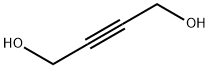
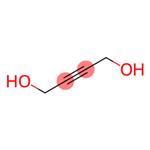
ChEBI: 2-Butyne-1,4-diol is a butynediol that is but-2-yne substituted by hydroxy groups at positions 1 and 4. It is used to produce butanedioland butenediol, in metal plating andpickling baths, and in making the carbamateherbicide Barban (Carbyne).
1,4-butynediol appears as white to light-brown solid or brownish-yellow aqueous solution. Solid sinks and mixes with water. (USCG, 1999)
Pure 2-Butyne-1,4-diol is non-explosvie. Small amounts of certain impurities-alkali hydroxides, alkaline earth hydroxides, halides-may cause explosive decomposition upon distillation. 2-Butyne-1,4-diol should not be treated with basic catalysts in the absence of a solvent at room temperature, and its stability is less with elevated temperatures. In strong acids, contamination with mercury salts can also result in violent decomposition [NFPA 491M 1991].
Toxic by ingestion. May explode on contamination with mercury salts, strong acids, and alkaline earth hydroxides and halides at high temperatures. May cause dermatitis.
2-Butyne-1,4-diol exhibits moderate to hightoxicity in test animals. It is about 10 timesmore toxic than are the saturated C4 diols.The oral LD50 value in rats is 0.125 mL/kg.It causes irritation to the skin.
Noncombustible solid, flash point (open cup)
152°C (305.6°F). It is stable at room temperature.
But the dry compound explodes in the
presence of certain heavy metal salts, such
as mercuric chloride. Heating with alkaline
solution may result in an explosion.
A poison by ingestion.
A skin sensitizer upon long or repeated
contact. Moderately explosive. When heated
to decomposition it emits acrid smoke and
fumes and may explode. Explosive reaction
with traces of alkaltes, alkali earth
hydroxides, halide salts, strong acids,
mercury salts + strong acids. See also
ACETYLENE COMTOUNDS.
2-butyne-1,4-diol is carried out by reaction under pressure of acetylene and an aqueous solution of formaldehyde, catalyzed by copper acetylide.
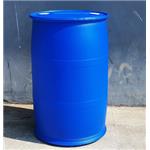
2-Butyne-1,4-diol can be stored in steel,aluminum, nickel, glass, epoxy, and phenolicliner containers. Rubber hose may be usedfor transfer. Avoid contact with heavy metalsalt contaminants.
Crystallise the diol from EtOAc. [Beilstein 1 IV 2687.]