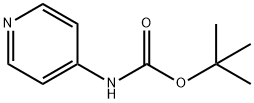
4-(Boc-amino)pyridine is a protected derivative of the amino acid Pyridine, a heterocyclic compound that is commonly found in biological specimens (such as human red blood cells), and is used as a starting reagent and intermediate in the chemical and pharmaceutical industries.
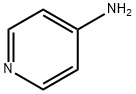
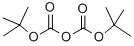
At room temperature, 4-aminopyridine (600 mg, 6.36 mmol), 4-dimethylaminopyridine (DMAP, 600 μg, 5.00 μmol), di-tert-butyl dicarbonate (Boc2O, 1.57 mL, 7.00 mmol) and triethylamine (Et3N, 1 mL, 7.63 mmol) were suspended in anhydrous tetrahydrofuran (THF, 3 mL) in anhydrous tetrahydrofuran (THF, 3 mL) and the reaction was stirred under argon protection for 20 min. After completion of the reaction, the reaction mixture was diluted with dichloromethane (CH2Cl2, 5 mL) and washed with 0.1 N hydrochloric acid (5 mL). The organic layers were combined, dried with anhydrous magnesium sulfate (MgSO4), filtered and concentrated by rotary evaporation. Finally, the target product 4-(tert-butoxycarbonylamino)pyridine (S1w, 1.30 g, yield >99%) was purified as a white solid by column chromatography (eluent ratio 30:1 dichloromethane/methanol).
[1] Tetrahedron Letters, 2006, vol. 47, # 7, p. 1087 - 1091
[2] Organic and Biomolecular Chemistry, 2006, vol. 4, # 14, p. 2769 - 2771
[3] Chemistry Letters, 2010, vol. 39, # 11, p. 1127 - 1129
[4] Bioorganic and Medicinal Chemistry, 2016, vol. 24, # 9, p. 2114 - 2124
[5] Tetrahedron Letters, 2007, vol. 48, # 47, p. 8318 - 8322