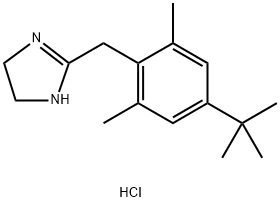
Starting with 1,3-dimethyl-5-tert-butylbenzene, it reacts with a chloromethylating agent in the presence of a catalyst to give 2,6-dimethyl-4-tert-butyl-1-chloromethylbenzene; cyanidation with sodium cyanide yields 2,6-dimethyl-4-tert-butyl-1-phenylacetonitrile, which is then cyclized with ethylenediamine p-toluenesulfonate to give xylometazoline p-toluenesulfonate (11); xylometazoline is then freed with alkali and reacted with hydrogen chloride to form a salt to give xylometazoline hydrochloride. The drawbacks of this process route are: tert-butyl-m-xylene has a high market price; chloromethyl ether is highly toxic, has a low boiling point, and a high market price; and highly toxic solvents such as carbon disulfide have low boiling points, resulting in poor reaction operability. Another synthetic route involves reacting 2,6-dimethyl-4-tert-butylaniline hydrochloride as a starting material with sodium nitrite, copper sulfate, and paraformaldehyde to generate 2,6-dimethyl-4-tert-butylbenzaldehyde. This is then reduced to an alcohol, followed by chloromethylation, hydrogenation, amino esterification, cyclization, and salt formation to produce xylometazoline hydrochloride. This synthetic route is lengthy and involves complex post-processing. Analysis shows that the diazotization reaction in this method generally has low yields; the use of thionyl chloride causes significant environmental pollution; it is difficult to scale up production; and the resulting product contains many impurities and has low purity. In summary, this synthetic method has a long process route, cumbersome post-processing, low product yield, and high production costs, making it difficult to achieve large-scale industrial production.
Xylometazoline hydrochloride is white or almost white, crystalline powder.
Xylometazoline hydrochloride may be used as a reference standard in determining the xylometazoline hydrochloride content in samples of nasal drops using high performance liquid chromatography (HPLC).
Xylometazoline hydrochloride is used as a nasal decongestant.
62 grams of para-tertiany-butyl-ortho,ortho'-dimethyl-phenyl-acetonitrile
[obtainable, for example, by the method of Buu-Hoi and P. Cagniant, Bulletin
de la Societe Chimique de France, volume 9, page 891 (1942)], 20.6 grams of
ethylenediamine of 96% purity and 1.55 cc of carbon disulfide are heated
together in a distillation flask with the exclusion of moisture for 48 hours on a
boiling water bath. Ammonia is evolved. Upon cooling the reaction product
solidifies and is then dissolved in benzene, the solution is filtered while hot
with the addition of animal charcoal and petroleum ether is added. The
mixture is filtered to remove the impurities that are first precipitated and by
the further addition of petroleum ether 2-(para-tertiary-butyl-ortho,ortho'-
dimethyl-phenyl-methyl)-imidazoline is caused to crystallize out.
The product melts at 131° to 133°C after being recrystallized from a mixture of benzene and petroleum ether. It can be converted into its hydrochloride as
follows:
189 grams of 2-(para-tertiary-butyl-ortho,ortho'-dimethyl-phenyl-methyl)-
imidazoline are dissolved in 400 cc of absolute ethanol, the solution is
rendered acid by the addition of 104 cc of an ethanolic solution of hydrochloric
acid of 30% strength, the mixture is filtered with the addition of animal
charcoal, and dry ethyl acetate and absolute ether are added until
crystallization sets in. After cooling the mixture, the salt is filtered off with
suction and crystallized several times from absolute ethanol with the use of
animal charcoal and the addition of dry mixture of ethyl acetate and ether.
The hydrochloride so obtained melts at 327° to 329°C (with decomposition).
Neo-Synephrine II (Sterling Winthrop); Otrivin
Hydrochloride (Ciba-Geigy).
Xylometazoline hydrochloride is a derivative of imidazole, and a representative of the class of α1 agonists. It is commonly used in nasal decongestants, which works on the principle of constricting the blood vessels in the mucous membranes.
α-adrenoceptor agonist; imidazoline binding site ligand.
Poison by ingestion, subcutaneous, intravenous, and intraperitoneal routes. When heated to decomposition it emits toxic fumes of NOx and HCl.