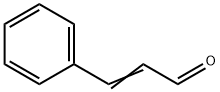
Cinnamic aldehyde is used as a flavoring agent, ingredient
of fragrance in soft drinks, ice creams, dentifrices,
pastries, chewing-gum, etc. It can induce both contact
urticaria and delayed-type reactions. It can be implicated
in contact dermatitis in those who work in the
perfume industry or food handlers. Cinnamic aldehyde
is contained in the "fragrance mix".
Cinnamaldehyde exists as yellowish to greenish-yellow oily liquid with a Strong pungent, spicy, cinnamon odor. It is normally insoluble in water and many organic solvents but is miscible with alcohol and other flavoring oils. Exposure to air will result in thickening and oxidation.
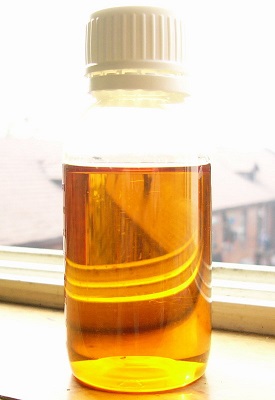
Cinnamaldehyde (cinnamic aldehyde, benzylideneactaldehyde, phenylacrolein, 3-phenylpropenal, 3-phenyl-2-propenal) is a saturated aldehyde with an aromatic ring that is a yellowish, oily liquid at room temperature. It is used as a flavoring and aromatic agent in a variety of food products, perfumes, and household products. It has also seen use as a rubber reinforcing agent. A burning taste that produces the odor and flavor of the spice may be found with this aromatic aldehyde. Cinnamaldehyde has also been used as an attractant for insect control, in the preparation of corrosion inhibitors, and as a coating for metals. Although extensively used in industry, it is also a natural constituent of cinnamon leaves and bark, some essential oils, and other plant products.
Reported found in celery seed, cinnamon, cinnamon leaf, cassia leaf, clove stem and lemon balm.
Cinnamic aldehyde is a common ingredient in perfumes for household products like deodorizers, detergents, and soap; flavor in toothpaste, sweets, ice cream, soft drinks, chewing gums, and cakes; in balsam of Tolu and Peru, hyacinth plant, spices, cinnamon, Ceylon and cassia oil;
some perfumery uses (Canoe; hyacinth; bubblegum; Balsam; Cassia); natural occurrence (cinnamon).
Cinnamaldehyde is used in flavor and perfumes.It occurs in cinnamon oils.
In the flavor and perfume industry.
ChEBI: (E)-cinnamaldehyde is the E (trans) stereoisomer of cinnamaldehyde, the parent of the class of cinnamaldehydes. It has a role as a hypoglycemic agent, an EC 4.3.1.24 (phenylalanine ammonia-lyase) inhibitor, a vasodilator agent, an antifungal agent, a flavouring agent, a plant metabolite and a sensitiser. It is a 3-phenylprop-2-enal and a member of cinnamaldehydes.
Detection at 50 to 750 ppb.
Taste characteristics at 0.5 ppm: spicy, cinnamon and cinnamon bark.
Yellow oily liquid with a cinnamon odor and sweet taste.
Thickens on exposure to air. May be unstable to prolonged exposure to air. Slightly water soluble .
Cinnamaldehyde reacts with sodium hydroxide owing to aerobic oxidation.
Cinnamaldehyde can cause moderate to severeskin irritation. Exposure to 40 mg in48 hours produced a severe irritation effecton human skin. The toxicity of this compoundwas low to moderate on test subjects,depending on the species and the toxicroutes. However, when given by oral routein large amounts, its poisoning effect wassevere. Amounts greater than 1500 mg/kghave produced a wide range of toxic effectsin rats, mice, and guinea pigs. The symptomswere respiratory stimulation, somnolence,convulsion, ataxia, coma, hypermotility, anddiarrhea.
LD50 value, oral (guinea pigs): 1150 mg/kg
Cinnamaldehyde is a mutagen. Its carcinogeniceffect is not established.
Cinnamaldehyde is combustible.
Fungicide, Insecticide: Used as an antifungal agent, corn rootworm attractant, and dog and cat repellent. Can be used on soil casing
for mushrooms, row crops, turf and all food commodities.
Not listed for use in EU countries.
ADIOS®; ZIMTALDEHYDE®;
ZIMTALDEHYDE® LIGHT
This perfumed molecule is used as a fragrance in perfumes,
a flavoring agent in soft drinks, ice creams,
dentifrices, pastries, chewing-gum, etc. It can induce
both contact urticaria and delayed-type reactions. It
can be responsible for dermatitis in the perfume
industry or in food handlers. Cinnamic aldehyde is
contained in “fragrance mix.” As a fragrance allergen,
it has to be mentioned by name in cosmetics within
the EU.
This is promising in antitumor activity against NSCLC cells. The cells were inducedin apoptosis and also the epithelial-mesenchymal transition was reversed affectingthe Wnt/b-catenin pathway (Bouyahya et al. 2016).
Poison by intravenous
and parenteral routes. Moderately toxic by
ingestion and intraperitoneal routes. A
severe human skin irritant. Mutation data
reported. Combustible liquid. May ipte
after a delay period in contact with NaOH.
When heated to decomposition it emits
acrid smoke and fumes. See also
ALDEHYDES.
By isolation from natural sources; synthetically, by condensation of benzaldehyde with acetaldehyde in the presence of
sodium or calcium hydroxide.
Botanical fungicide and insecticide. Used as an antifungal agent, corn rootworm attractant, and dog and cat repellent. Can be used on soil casing for mushrooms, row crops, turf, and all food commodities. Not listed for use in EU countries.
UN1989 Aldehydes, n.o.s., Hazard Class: 3; Labels: 3-Flammable liquid
Aldehydes are frequently involved in selfcondensation or polymerization reactions. These reactions are exothermic; they are often catalyzed by acid. Aldehydes are readily oxidized to give carboxylic acids. Flammable and/or toxic gases are generated by the combination of aldehydes with azo, diazo compounds, dithiocarbamates, nitrides, and strong reducing agents. Aldehydes can react with air to give first peroxo acids, and ultimately carboxylic acids. These autoxidation reactions are activated by light, catalyzed by salts of transition metals, and are autocatalytic (catalyzed by the products of the reaction). The addition of stabilizers (antioxidants) to shipments of aldehydes retards autoxidation. Incompatible with oxidizers (chlorates, nitrates, peroxides, permanganates, perchlorates, chlorine, bromine, fluorine, etc.); contact may cause fires or explosions. Keep away from alkaline materials, strong bases, strong acids, oxoacids, epoxides, ketones, azo dyes, caustics, boranes, hydrazines
Incineration. In accordance with 40CFR165, follow recommendations for the disposal of pesticides and pesticide containers.