General Description
A white to light yellow crystalline solid. Contact may severely irritate skin and eyes. Poisonous by ingestion and moderately toxic by skin contact.
Reactivity Profile
4-NITROPHENOL(100-02-7) is a slightly yellow, crystalline material, moderately toxic. Mixtures with diethyl phosphite may explode when heated. Decomposes exothermally, emits toxic fumes of oxides of nitrogen [Lewis, 3rd ed., 1993, p. 941]. Decomposes violently at 279°C and will burn even in absence of air [USCG, 1999]. Solid mixtures of the nitrophenol and potassium hydroxide (1:1.5 mol) readily deflagrate [Bretherick, 5th Ed., 1995].
Air & Water Reactions
Soluble in hot water and more dense than water.
Hazard
Toxic by ingestion.
Health Hazard
Inhalation or ingestion causes headache, drowsiness, nausea, and blue color in lips, ears, and fingernails (cyanosis). Contact with eyes or skin causes irritation; can be absorbed through skin to give same symptoms as for inhalation.
Description
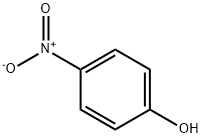
4-Nitrophenol (also called p-nitrophenol or 4-hydroxynitrobenzene)
is a phenolic compound that has a nitro group at the
opposite position of hydroxyl group on the benzene ring.
4-Nitrophenol shows two polymorphs in the crystalline state.
The alpha form is colorless pillars, unstable at room temperature,
and stable toward sunlight. The beta form is yellow pillars,
stable at room temperature, and gradually turns red upon
irradiation of sunlight. Usually 4-nitrophenol exists as
a mixture of these two forms. Generally, 4-nitrophenol is used
in manufacturing of drugs (e.g., acetaminophen), fungicides,
methyl and ethyl parathion insecticides, and dyes, and to
darken leather.
Chemical Properties
Yellow to tan crystals or powder
Uses
4-Nitrophenol is used in dyestuff and pesticide synthesis, as a
fungicide, bactericide, and wood preservative, as a chemical
indicator, and as a substrate for experiments on cytochrome
P450 2E1.
Uses
manufacture of pharmaceuticals, fungicides, dyes. Indicator in 0.1% alcohol solution. pH: 5.6 colorless, 7.6 yellow.
Uses
Used in the manufacturing of pharmaceuticals, fungicides, dyes.
Application
4-Nitrophenol (4-NP) is used to manufacture pharmaceuticals, fungicides, insecticides, and dyes and to darken leather. Indicator in 0.1% alcohol solution. pH: 5.6 colorless, 7.6 yellow. It can be used to prepare 4-aminophenol (4-AP), a key intermediate for the manufacture of analgesic and antipyretic drugs.
Definition
ChEBI: 4-nitrophenol is a member of the class of 4-nitrophenols that is phenol in which the hydrogen that is para to the hydroxy group has been replaced by a nitro group. It has a role as a human xenobiotic metabolite and a mouse metabolite. It is a conjugate acid of a 4-nitrophenolate.
Preparation
4-Nitrophenol was synthesized from p-nitrochlorobenzene by hydrolysis and acidification. Add 2320-2370L of sodium hydroxide solution with a concentration of 137-140g/L to the hydrolysis pot, and then add 600kg of molten p-nitrochlorobenzene. Heat to 152℃, pressure in the pot is 0.4MPa, then stop heating, the hydrolysis reaction exotherm makes the temperature and pressure rise naturally to 165℃, about 0.6MPa. keep 3h and take sample to check the end point of the reaction, after the reaction is finished, the hydrolysate is cooled to 120℃. Add 600L water and 50L concentrated sulfuric acid to the crystallization pot, press into the above hydrolysis and cool to about 50℃, add concentrated sulfuric acid to make the Congo red test paper purple, continue to cool to 30℃, filter, centrifuge to shake off the water, get more than 90% of 4-nitrophenol about 500kg, 92% yield.
Flammability and Explosibility
Nonflammable
Synthesis
4-Nitrophenol is synthesized by Nitration of para-Toluenesulfonic ester of Phenol, followed by hydrolysis is obtained a fairly pure material.
Metabolic pathway
4-[U-14C]Nitrophenol is conjugated as its b-glucoside
(ca 22% of applied 14C) and gentiobioside, glc-
b(126)-glc-b-4-nitrophenol (ca 64%), while about 7%
of the parent remains unchanged in cell suspension
cultures of Datura stramonium (L.). Gal-b-4-nitrophenol
is found to be a minor metabolite.
Purification Methods
Crystallise 4-nitrophenol from water (which may be acidified, e.g. with N H2SO4 or 0.5N HCl), EtOH, aqueous MeOH, CHCl3, *benzene or pet ether, then dry it in vacuo over P2O5 at 25o. It can be sublimed at 60o/10-4mm. The 4-nitrobenzoate had m 159o (from EtOH). [Beilstein 6 IV 1279.]
Toxicity evaluation
The major hazards has been encountered in the use and
handling of 4-nitrophenolstem from its toxicologic properties.
4-Nitrophenol irritates the eyes, skin, and respiratory tract. It
may also cause inflammation of those parts. It has a delayed
interaction with blood and forms methemoglobin which is
responsible for methemoglobinemia, potentially causing
cyanosis, confusion, and unconsciousness. When ingested, it
causes abdominal pain and vomiting. Prolonged contact with
skin may cause allergic response.
Toxics Screening Level
The Initial Threshold Screening Level (ITSL) is 0.7 μg/m3 with an annual averaging time.