GENERAL METHODS: Coumarin-4-acetic acid is a known compound (Manware et al., 2008). The reaction conditions for this compound were modified and optimized (Method A) to synthesize the analogues 2a-2f. These analogues were also synthesized by microwave-assisted methods (Method B).
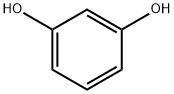
Method A: A mixture of citric acid (0.02 mol) and concentrated sulfuric acid (0.03 mol) was stirred at room temperature for 30 min. The mixture was placed in a boiling water bath to remove carbon monoxide (note: this needs to be done in a fume hood). Once the release of CO gas slowed down, the flask was removed from the water bath and left to stand for 15 minutes or until no more CO bubbles were produced in the reaction mixture. The reaction mixture was cooled to 10 °C and (un)substituted phenol (0.02 mol), pre-cooled to 10 °C, was added dropwise. The reaction mixture was stirred at room temperature for 48 h and then decanted onto ice. The precipitate was filtered and dissolved in saturated sodium bicarbonate solution. The solution was acidified to give intermediates 2a-2f.
Method B: A mixture of citric acid (0.02 mol), concentrated sulfuric acid (0.03 mol), and (un)substituted phenol (0.02 mol) was placed in a microwave reactor and heated at 10% power for 4 min. The reaction mixture was poured onto crushed ice and processed according to the subsequent steps of Method A to obtain the target product.
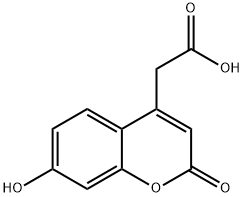
Yield of 7-hydroxycoumarin-4-acetic acid (2a): 67% for Method A and 78% for Method B; melting point: 170°C; IR (FT-IR) νmax (cm1): 3210 (Ar C-H), 2924 (Al C-H), 1710 (C=O), 1701 (lactone C=O), 1458 (C=C), 1130 (C-O) , 1290 (C-OH); 1H-NMR (DMSO-d6, 400 MHz): δ 11.08 (1H, s, COOH), 7.41-6.98 (2H, m, H-5 and H-6), 6.69-6.23 (2H, m, H-8 and H-3), 4.93 (1H, dd, OH), 3.02-2.89 (2H, m , CH2); 13C-NMR (DMSO-d6, 100 MHz): δ 171.5 (C=O), 160.2 (C-2), 112.5 (C-3), 152.4 (C-4), 150.5 (C-8a), 135.2 (C-6), 124.8 (C-5), 122.9 (C-7), 120.1 (C-4a ), 104.1 (C-8), 37.0 (-CH2). HRMS (+ESI) [M+H]+: 221.0445 (calculated value), 221.0464 (measured value).