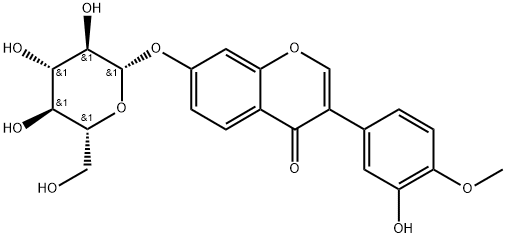
White crystalline powder, soluble in methanol and ethanol, derived from the rhizome of Astragalus membranaceus.
Calycosin 7-O-β-D-glucoside is one of seven constituent in Guanjiekang (GJK) that is formed by five medicinal herbs that is used for the rheumatoid arthritis (RA).
ChEBI: Calycosin-7-O-beta-D-glucoside is a glycosyloxyisoflavone that is calycosin substituted by a beta-D-glucopyranosyl residue at position at 7 via a glycosidic linkage. It is a hydroxyisoflavone, a monosaccharide derivative, a member of 4'-methoxyisoflavones and a 7-hydroxyisoflavones 7-O-beta-D-glucoside. It is functionally related to a calycosin.
Calycosin-7-O-β-D-glucoside (intraperitoneal injection; 26.8 mg/kg; 14 days) significantly reduces infarct volume, histological damage and BBB permeability in the in vivo MCAO ischemia-reperfusion rat model[1].
| Animal Model: | Middle cerebral artery occlusion (MCAO) male adult Sprague-Daweley rats[1] |
| Dosage: | 26.8 mg/kg |
| Administration: | Intraperitoneal injection; 26.8 mg/kg; 14 days |
| Result: | Exhibited neuroprotective effects in rats. |