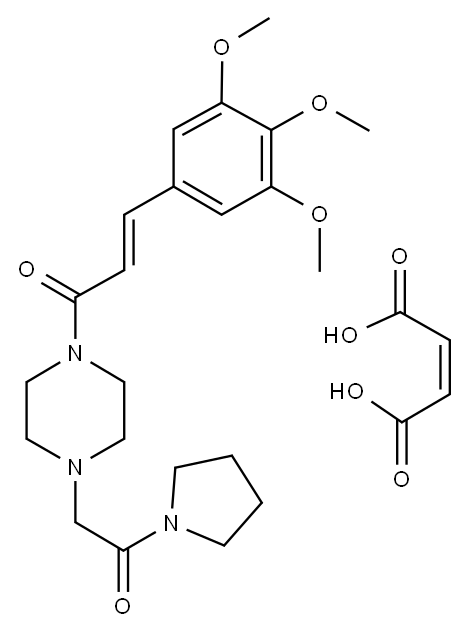
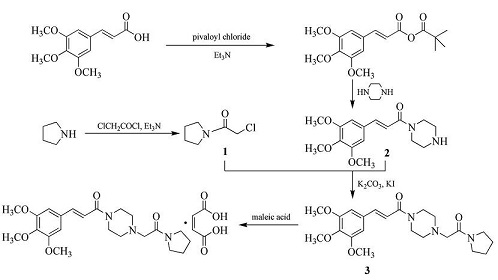
Route 1: N-(2-chloroacetyl)tetrahydropyrrole is prepared by reacting chloroacetyl chloride with tetrahydropyrrole (1); a mixed anhydride is prepared by reacting (E)-3,4,5-trimethoxycinnamic acid with pentanoyl chloride, and then reacted with piperazine to prepare (E)-1-(3,4,5-trimethoxy)cinnamoylpiperazine (2); intermediate 1 reacts with intermediate 2 to prepare cinnamoylpiperazine free base 3, and finally reacts with maleic acid in ethanol to obtain the target product. This route is more suitable for industrial production. The specific reaction process is as follows:
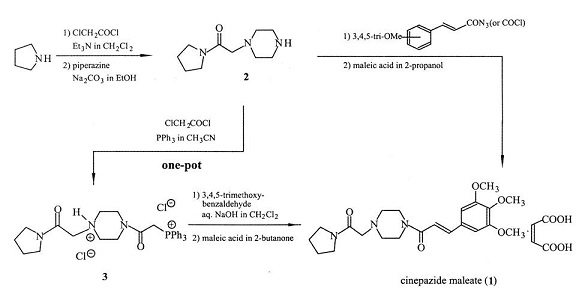
Route 2: Using tetrahydropyrrole as a raw material, it is first reacted with chloroacetyl chloride to form an amide, and then reacted with piperazine to undergo a substitution reaction to obtain the intermediate [(1-tetrahydropyrrole)methyl]piperazine (2); Compound 2 reacts with chloroacetyl chloride and triphenylphosphine, and is recrystallized from isopropanol to obtain a stable organic salt (3); Compound 3 undergoes a Wittig reaction with 3,4,5-trimethoxybenzaldehyde, and is then reacted with maleic acid to form a salt to obtain the target compound Cinepazide maleate (1). The overall yield is 52.3%; the stable crystal form of Cinepazide maleate can be obtained by recrystallization with ethanol-butanone, and then with butanone. The specific reaction process is as follows: