(1) Dissolve 45g of chloroethane in 300g of xylene and set aside; (2) Add 10g of triethylamine, 50g of diethyl ether, and 150g of xylene to a high-pressure reactor. At 70°C, add 250g of chloroethane-xylene solution dropwise to the high-pressure reactor. After the addition is complete, keep the reactor at this temperature for half an hour. Then, introduce gas to maintain the pressure inside the high-pressure reactor at 3MPa. React at 120°C for 12 hours. Stop the gas supply, slowly open the vent valve, and cool down to room temperature; (3) Filter the reaction solution obtained in step (2) to obtain 58.3g of filter cake A, which is crude tetraethylammonium chloride. Add the crude tetraethylammonium chloride to 100g of water and stir at 45°C until most of the crude product dissolves. Filter while hot to obtain 20.2g of filtrate. Add the filtrate to a mixed solvent of 80g of acetonitrile and 120g of pentanediol. Stir and let stand for half an hour, then filter. Dry the filter cake B to obtain 15.9g of tetraethylammonium chloride. The purity is 99.7%, and the yield is 95.5%.
Tetraethylammonium Chloride is a white crystalline powder. The solubility is 1000000 mg/L at 25 °C.
Tetraethylammonium chloride (TEAC) has been used:
- used for inhibition of peroxynitrite induced relaxation in rat aorta rings
- as a pharmacological blocker of K+ current and Ca2+ induced K+ current in antennal lobe neurons
- for the induction of TEAC sensitive currents in cochlear inner hair cells digested with proteolytic enzymes and analyze its properties
Medicine (nerve-blocking agent).
Tetraethylammonium Chloride can be used as a source of tetraethylammonium ions for various pharmaceutical studies and has the ability to block K+ channels in various tissues. Tetraethylammonium Chloride can also block the transmission of nervous impulses across autonomic ganglions.
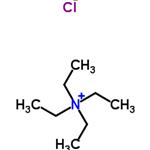
ChEBI: Tetraethylammonium chloride is a quarternary ammonium chloride salt in which the cation has four ethyl substituents around the central nitrogen. It has a role as a potassium channel blocker. It is a quaternary ammonium salt and an organic chloride salt. It contains a tetraethylammonium.
Tetraethylammonium Chloride is a strong irritant to the skin and eyes and may be harmful to the heart and central nervous system. Oral, intraperitoneal and intramuscular lethal dose studies in mice and rats caused drowsiness, tremors and muscle weakness; intravenous injection of 5 mg/kg in humans caused paralysis, mydriasis and ptosis.
Non-selective K + channel blocker.
Tetraethylammonium chloride (TEAC) blocks K+ channels non-specifically. In rat aorta rings, tetraethylammonium inhibits relaxation induced by peroxynitrite. It blocks nicotinic acetylcholine neurotransmission by blocking the receptor-mediated K+ currents. TEAC can increase the contractility and mobility of colon and rectum and is a therapeutic option for Hirschsprung′s disease patients. TEAC reduces the inflammatory responses, improves cardiac, vascular and hemodynamic properties during early sepsis in animals. TEAC has cytotoxic and anti-proliferative potential and induces apoptosis in glioma cells by downregulating B-cell lymphoma-2 (Bcl-2) and upregulating Bcl-2 associated X (Bax).
tetraethylammonium (tea) is a small ion that is thought to block open k channels by binding either to an internal or to an external site. for this reason, it has been used to probe the ion conduction pathway or pore of k channel mutants and a k channel chimera. tea blocks k+ channels at two sites, which define the inner and outer mouths of the channel pores [1].
vasorelaxant effect of taurine can be diminished by tea in rat isolated arteries [2]
Room temperature (desiccate)
Crystallise the chloride from EtOH by adding diethyl ether, from warm water by adding EtOH and diethyl ether, from dimethylacetamide or from CH2Cl2 by addition of diethyl ether. Dry it over P2O5 in vacuum for several days. It also crystallises from acetone/CH2Cl2/hexane (2:2:1) [Blau & Espenson J Am Chem Soc 108 1962 1986, White & Murray J Am Chem Soc 109 2576 1987]. [Beilstein 4 IV 332.]
[1] taglialatela m, vandongen am, drewe ja, joho rh, brown am, kirsch ge. patterns of internal and external tetraethylammonium block in four homologous k+ channels. mol pharmacol. 1991 aug;40(2):299-307.
[2] niu lg, zhang ms, liu y, xue wx, liu db, zhang j, liang yq. vasorelaxant effect of taurine is diminished by tetraethylammonium in rat isolated arteries. eur j pharmacol. 2008 feb 2;580(1-2):169-74. epub 2007 oct 25.
[3] shea pa, dunklee pe, et al. preliminary clinical investigation of tetraethylammonium chloride with particular reference to disorders of the circulatory system. calif med. 1948 sep;69(3):193-6.