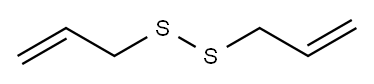
Diallyl disulfide is one of the major allergens in garlic (Allium sativum) and onions. Among patients who are patch-test positive to garlic, all 13 who were tested had positive reactions to diallyl sulfide 5% petrolatum.
Allyl disulfide is a clear yellow liquid with a characteristic garlic odor. It is used as a flavor enhancer, flavoring agent, or adjuvant.
Main constituent of Allium sativum essential oil. Reported found in onion (Allium cipa, L.), garlic (Allium
sativum L.), chive (Allium schoenoprasum L.), nira (Allium tuberosum rottl.), raw cabbage and caucas (Allium victoralis L.).
Diallyl disulfide is one of the three principallow-molecular-weight allergens of garlic. Allylpropyl disulfide and allicin are the other allergens.
antineoplastic, antibacterial, apoptosis inducer, insecticide
Diallyldisulfide has a range of uses varying from a Cytocrome P450 inhibitor to vasorelaxant and hypotensive. Being in the class of organosulfur compounds, it carries chemopreventive characteristics .
Diallyl disulfide can be prepared by oxidation of allyl mercaptan with iodine in the presence of pyridine and ethanol, or from sodium allyl thiosulfate using potassium hydroxide.
ChEBI: Diallyl disulfide is an organic disulfide where the organic group specified is allyl. It has been isolated from garlic and other species of the genus Allium. It has a role as an antineoplastic agent, an antifungal agent and a plant metabolite.
Detection: 4.3 to 30 ppb; Recognition: 80 ppb
Taste characteristics at 2 ppm: green onion and garlic-like with meaty nuances
Allyl disulfide is naturally found in Allium species such as garlic and onion. It is used as a flavoring agent in meat and condiments.
Diallyldisulfide is one of the major allergens in garlic (Allium sativum) and onions. Among patients patch-testpositive to garlic, all 13 who were tested had positive reactions to diallyl sulfide 5% pet.
Organosulfur compound that is naturally found in garlic. Contributes to the pungent odor of crushed garlic. Anticancer agent and may provide protection against cardiovascular disease.
Reported uses (ppm): (FEMA, 1994)
| Food Category |
Usual |
Max. |
| Alcoholic beverages |
0.1 |
1 |
| Baked goods |
9.09 |
13.16 |
| Condiments, relishes |
13.82 |
15.21 |
| Frozen dairy |
0.1 |
1 |
| Gelatins, puddings |
0.5 |
1 |
| Gravies |
2 |
6.5 |
| Meat products |
9.4 |
13.1 |
| Nonalcoholic beverages |
0.07 |
0.68 |
| Soft candy |
0.5 |
1 |
| Soups |
1 |
10 |
Purify the disulfide by fractional distillation until the molar refractivity is in uniformly good agreement with the calculated value [Small et al. J Am Chem Soc 69 1710 1947]. It has also been purified by gas chromatography [retention times: Carson & Wong J Org Chem 24 175 1959, UV: Koch J Chem Soc 395 1949]. It is present in garlic. [Beilstein 1 IV 2098.]
CoE: Used provisionally. Food: 5 ppm
FDA: 21 CFR 172.515
FDA (other): n/a
JECFA: ADI: Acceptable. No safety concern at current levels of intake when used as a flavoring agent (1999).