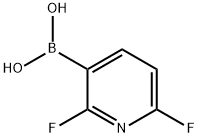
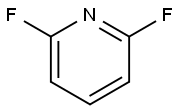
The general procedure for the synthesis of 2,6-difluoropyridine-3-boronic acid from 2,6-difluoropyridine and trimethyl borate was carried out as follows: the synthesis was carried out according to the methodology reported in the literature [S1, S2] with appropriate modifications. First, a solution of lithium diisopropylammonium (LDA) was prepared by slow dropwise addition of a THF (20 mL) solution of diisopropylamine (3.4 mL) to n-butyllithium (1.67 M in n-hexane, 24 mmol, 14 mL) at 20 °C, followed by stirring at 0 °C for 20 min. Next, in another reaction flask, a solution of 2,6-difluoropyridine (20 mmol, 1.8 mL) in THF (20 mL) was stirred at -78 °C and the LDA solution prepared above was added via cannula. After continued stirring at -78 °C for 30 min, a solution of trimethyl borate (24 mmol, 2.5 g, 2.7 mL) in THF (10 mL) was added to the reaction mixture, followed by a slow warming up to room temperature over a period of 1 hour. Upon completion of the reaction, the reaction was quenched with 2 M aqueous sodium hydroxide solution (40 mL). The aqueous layer was separated and the pH was adjusted to 8 with 4 M hydrochloric acid followed by extraction with ethyl acetate (organic layer A). The pH of the aqueous layer was further adjusted to 6.5 with 4M hydrochloric acid, at which time insoluble organic matter was precipitated, and the extraction was repeated three times with ethyl acetate to give organic layer B. The pH of the aqueous layer was again adjusted to 4 with 4M hydrochloric acid, and the extraction was repeated three times with ethyl acetate to give organic layer C. Organic layers B and C were combined, dried with anhydrous sodium sulfate, and concentrated under reduced pressure to afford the crude product of 2,6-difluoropyridinium-3-boronate in 94% (3.0 g) yield. 94% (3.0 g, 19 mmol). The product could be used directly in the subsequent reaction without further purification.