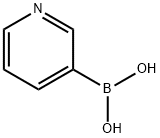
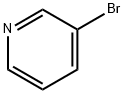
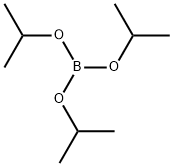
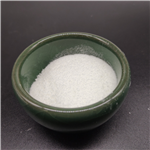
The general procedure for the synthesis of pyridine-3-boronic acid from 3-bromopyridine and triisopropyl borate was as follows: first, pyridine-3-boronic acid (1-6) was prepared by subsequent hydrolysis via an appropriate esterification reaction according to the method of Cai et al. (Tetrahedron Lett. 43: 4285-4287, 2002). This was done as follows: 85 mL of toluene was added to a 500 mL three-necked flask, cooled to below -60°C, and then 1.6 M of n-BuLi hexane solution (48.6 mL, 77.8 mmol) was added dropwise over 10 min. After the internal temperature reached -60°C, a toluene solution (30 mL) of 3-bromopyridine (6.8 mL, 70.7 mmol) was slowly added dropwise to keep the internal temperature below -50°C. At this point, a brownish-black solid precipitated, and the resulting slurry was stirred for 20 min. Next, 30 mL of THF was added dropwise to keep the internal temperature below -50°C and stirring was continued for 15 min. Subsequently, triisopropyl borate (19.6 mL, 84.9 mmol) was added all at once via syringe. The solution was slowly heated to -15°C, and the reaction was quenched with 2.7 N aqueous HCl (70.0 mL) and transferred to a partition funnel. The aqueous layer was separated and the organic layer was washed with 10 mL of water. The combined aqueous layers were neutralized to pH 7 with 10 N NaOH aqueous solution and extracted with THF (200 mL x 1, 125 mL x 2). The organic phases were combined and concentrated under reduced pressure. The residue was dissolved in THF/CH3OH (1:1, 140 mL), filtered and diluted with CH3CN to 300 mL.The solvent was converted to CH3CN by distillation and concentrated to 100 mL.The solids were collected by filtration to afford pyridine-3-boronic acid 1 (6.4 g, 73% yield) as an off-white solid. The product was confirmed by 1H NMR (CD3OD): δ 8.64 (br s, 1H), 8.50 (m, 1H), 8.38 (br s, 1H), 7.65 (br s, 1H). The product can be used directly in Suzuki cross-coupling reaction.