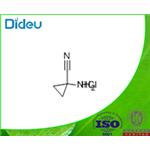
Uses
1-Amino-1-cyclopropanecarbonitrile hydrochloride serves as a starting material for constructing the pyrimidine ring and synthesizing the heterocyclic building block 1-(pyrimidin-2-yl)cyclopropan-1-amine hydrochloride, where it is converted into an N-Cbz protected amidine intermediate[1]. The compound couples with acyl chloride intermediates, such as those derived from 4-octylbenzoic acid, to form benzamide derivatives[2].
Synthesis
An aqueous solution of sodium hydroxide (91 g, 2.275 mol) was added to a 2L flask and cooled to zero degrees under nitrogen before benzyltriethylammonium chloride (2.0 g, 0.0088 mol), (phenylmethyleneammonium) acetonitrile (47.89 g), and toluene (100 mL) were added to the reaction system. Then 1,2-dibromoethane (23 ml, 122.4 mmol) was added dropwise to the reaction mixture over 25 minutes, mechanically stirred and cooled to maintain an internal temperature close to 10 degrees C. The reaction mixture was then vigorously stirred at room temperature for 24 hours before being poured into ice water and extracted with toluene, and the combined extract was washed with brine and then dried with anhydrous MgSO4, filtered, and the oil was extracted by rotary Toluene was removed by evaporation to give an oily compound (67 g), the residue was dissolved in boiling n-hexane (400 ml) and cooled by hot filtration, a dark-colored oily compound could be isolated, which was removed with a pipette (ca. 2 ml) and cooled for 2 hr at zero degrees Celsius before scraping-induced crystallization was carried out on the remaining solution, the light-yellow crystals were collected by filtration, and washed with zero degrees Celsius n-hexane to give the Intermediate 1-(phenylmethylene)cyclopropanecarbonitrile (30.56 g). 1-(Phenylmethylene)cyclopropanecarbonitrile (30.56 g, 0.124 mol) well concentrated hydrochloric acid (12 ml) was dissolved in a mixed solvent of water (100 ml) and ether (100 ml), and the resulting mixture was stirred and reacted for 15 hrs at room temperature, and the ether layer was separated, and then the aqueous layer was washed with ether. Then the aqueous layer was freeze-dried to obtain 1-aminocyclopropanecarbonitrile hydrochloride as a tan powder (13.51 g). [
References
[1]
Schäfer, G., Ahmetovic, M., Fleischer, T., Abele, S. (2020). Development of a Scalable Route for a Highly Polar Heterocyclic Aminocyclopropyl Building Block. Organic Process Research Development, 24(9), 1735–1742.
https://doi.org/10.1021/acs.oprd.0c00358 [2]
Mathews, T. P., Kennedy, A. J., Kharel, Y., Kennedy, P. C., Nicoara, O., Sunkara, M., Morris, A. J., Wamhoff, B. R., Lynch, K. R., Macdonald, T. L. (2010). Discovery, Biological Evaluation, and Structure−Activity Relationship of Amidine Based Sphingosine Kinase Inhibitors. Journal of Medicinal Chemistry, 53(7), 2766–2778.
https://doi.org/10.1021/jm901860h