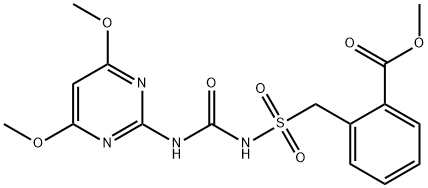
Definition
ChEBI: The methyl ester of bensulfuron. An acetolactate synthase inhibitor, it is used as a herbicide for the control of a variety of both annual and perennial weeds in crops, particularly wheat and rice. It is not licensed for use within the UK.
Description
Bensulfuron-methyl (BSM) is a new kind of sulfonylurea herbicide widely used to control various weeds and sedges. It is moderately soluble in water, non-volatile and moderately mobile. It would not be expected to persistent in soil but could be persistent in water systems under certain conditions. It is not highly toxic to mammals. It also shows a low toxicity to birds and earthworms but is more of a concern to aquatic plants, algae and honeybees.
Chemical Properties
The pure product is a white, odorless solid with an mp of 185-188°C and a vapor pressure of 1.733×10⁻³ Pa (20°C). Its solubility is 11720 mg/L in dichloromethane, 5380 mg/L in acetonitrile, 280 mg/L in xylene, 1660 mg/L in ethyl acetate, 1380 mg/L in acetone, 990 mg/L in methanol, 3.1 mg/L in hexane, and 1200 mg/L in water. Its partition coefficient is 4.1. It is stable in slightly alkaline aqueous solutions (pH 8) and decomposes slowly in acidic solutions. Its half-life is 11 days at pH 5 and 143 days at pH 7. The original drug has a slightly pale yellow tint.
Production Methods
Bensulfuron-methyl is synthesised through a multi-step process involving sulfonylurea chemistry. The production begins with the preparation of key intermediates such as 2-amino-4,6-dimethoxypyrimidine, which is obtained by chlorinating and methoxylating pyrimidine derivatives. Separately, O-methoxy carboxyl benzylsulfo isocyanate is synthesised by reacting phosgene with benzylsulfamide derivatives, followed by gas stripping to remove excess reagents. These two intermediates are then combined in a synthesis kettle, where they react under controlled conditions to form bensulfuron-methyl. The final product is isolated through centrifugal separation.
Mechanism of action
Selective, systemic action being absorbed through foliage and roots. Inhibits plant amino acid synthesis - acetohydroxyacid synthase AHAS
Safety Profile
Moderately toxic by ingestion.When heated to decomposition it emits toxic vapors ofNOx and SOx.
Metabolic pathway
Bensulfuron methyl is metabolized by mammals and
birds and the major metabolites identified include
mono-O-demethylated and 5-hydroxylated bensulfuron
methyl and 5-hydroxy-2-amino-3,5-
dimethoxypyrimidine. As bird metabolites, cleavage of
the pyrimidine ring of bensulfuron methyl is observed which results in two pyrimidine ring-opening
metabolites. In rice plants, bensulfuron methyl
undergoes rapid O-demethylation at one of the
methoxy groups on the pyrimidine ring which will
proceed through hydroxylation at the methyl group.
Alcoholysis and hydrolysis of bensulfuron methyl (H1)
involve mainly the breakdown of the urea moiety
which leads to several degradation products, some of
which are also identified as metabolites in mammals
and plants.