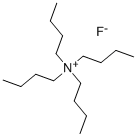
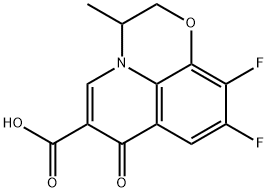
Example 1: Preparation of 9,10-difluoro-2,3-dihydro-3-methyl-7-oxo-7H-pyrido[1,2,3-de][1,4]benzoxazine-6-carboxylic acid (I). 220 mg (0.447 mmol) of ethyl 2-(2-nitro-3,4,5-trifluorobenzoyl)-3-(1-tert-butyldimethylsilylmethoxypropan-2-ylamino)acrylate (II) was dissolved in 10 mL of tetrahydrofuran and the solution was cooled to 0 °C. To this solution 0.41 g (1.56 mmol) of tetrabutylammonium fluoride in tetrahydrofuran was added dropwise and stirred for 30 min. Subsequently, the reaction mixture was heated to reflux for 30 minutes. 2 mL of 10% aqueous potassium hydroxide solution was added and refluxing was continued for 30 minutes. After cooling to room temperature, the reaction mixture was filtered to remove insoluble material. The filtrate was concentrated under reduced pressure (25 °C/10 mmHg) and 20 mL of water was added to the residue. The aqueous phase was washed once with 5 mL of chloroform and then the pH was slowly adjusted to 3 with 1 N hydrochloric acid solution. the precipitate was collected by filtration, washed sequentially with 5 mL of water and 5 mL of a mixture of ethanol and ether (1:4, v/v/v), and dried to give 108 mg of the target product (86% yield). The melting point of the product was 308 °C (decomposition); NMR (TFA-d1) δ ppm: 9.39 (1H, s), 8.10 (1H, dd, J = 10.8 Hz), 5.11-5.26 (1H, m), 4.79 (1H, dd, J = 2.12 Hz), 4.65 (1H, dd, J = 2.12 Hz), 1.82 (3H, d. J = 6.7 Hz).

![Benzenepropanoic acid, α-[[[2-[[(1,1-dimethylethyl)dimethylsilyl]oxy]-1-methylethyl]amino]methylene]-3,4,5-trifluoro-2-nitro-β-oxo-, ethyl ester, (E)- (9CI)](/CAS/20210305/GIF/178233-30-2.gif)