Description
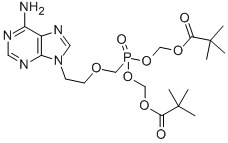
Adefovir dipivoxil is the first nucleotide analog to be launched in the US as an oral
treatment for hepatitis B virus (HBV) infections. It can be easily prepared in 4 steps from
adenine. Adefovir dipivoxil acts as a bioavailable ester prodrug which is rapidly hydrolyzed
to free adefovir and further anabolized to its active form, adefovir diphosphate, by two
intracellular phosphotylation steps. The diphosphate competitively inhibits reverse
transcriptase and/or causes chain termination when incorporated into growing DNA.
Adefovir dipivoxil has a broad antiviral spectrum against retro-, herpes- and
hepadnaviruses. The drug inhibits HBV replication, decreases HBV DNA levels and
improves liver histology of patients infected with HBV wild type and resistant to other
antivirals such as lamivudine. It also demonstrated activity in hepatitis B”e” antigennegative,
or precore mutant, patients and in patients co-infected with HIV. To date, no
adefovir dipivoxil-associated resistance mutations have been identified in patients up to
136 weeks with the drug. The oral bioavailability of adefovir after oral administration of its
dipivoxil prodrug is approximately 30%. It is mainly excreted unchanged in the urine and its
plasma elimination half-life is 4.2 h. However, a long intracellular half-life (17 h) of the
active bisphosphorylated metabolite enables once-daily dosing. The most prominent
adverse effect of adefovir dipivoxil is nephrotoxicity (which has prevented the drug from
being marketed for HIV infections where the drug required administration at higher doses).
Chemical Properties
White Solid
Originator
Institute of Organic Chemistry
and Biochemistry of the Academy of Sciences in the Czech Republic and the REGA Stichting Research (Czech Republic, Belgium)
Definition
ChEBI: Adefovir pivoxil is an organic phosphonate that is the dipivoxil ester of adefovir. A prodrug for adefovir, an HIV-1 reverse transcriptase inhibitor, adefovir pivoxil is used to treat chronic hepatitis B viral infection. It has a role as a prodrug, an antiviral drug, a DNA synthesis inhibitor, a HIV-1 reverse transcriptase inhibitor and a nephrotoxic agent. It is an organic phosphonate, a member of 6-aminopurines, an ether and a carbonate ester. It is functionally related to an adefovir.
Brand name
Hepsera (Gilead Sciences).
General Description
Adefovir is an orally active prodrug that is indicated for thetreatment of the chronic form of hepatitis B. The dipivoxil moieties are hydrolyzed by ubiquitous esterases to yieldadefovir, which is phosphorylated by adenylate kinase toyield adefovir diphosphate. This compound is inhibitory atHBV DNA polymerase. In addition, adefovir undergoes incorporationinto viral DNA and causes chain termination.Adefovir is poorly absorbed by the oral route, but the dipivoxilester groups cause the bioavailability to increase toapproximately 60%.
Mechanism of action
Adefovir dipivoxil is an orally active prodrug indicated for the treatment of chronic hepatitis B. The drug
is hydrolyzed by extracellular esterases to produce adefovir, which in turn is phosphorylated by
adenylate kinase to adefovir diphosphate, which inhibits HBV DNA polymerase. Incorporation of adefovir
into viral DNA also leads to DNA chain termination. As shown in Figure 43.9, adefovir dipivoxyl is
activated in two steps involving an esterase that exposes a free phosphate group (adefovir), followed by
addition of a second phosphate by adenylate kinase to form adefovir diphosphate, the active form of the drug.
Clinical Use
Adefovir dipivoxil joins interferon and lamivudine in the treatment of chronic HBV. It can be used singly or in combination with lamivudine. Early clinical studies indicate benefit of the use of adefovir dipivoxil to treat lamivudine-resistant HBV with a low level of resistant virus developing to monotherapy with adefovir dipivoxil.
Synthesis
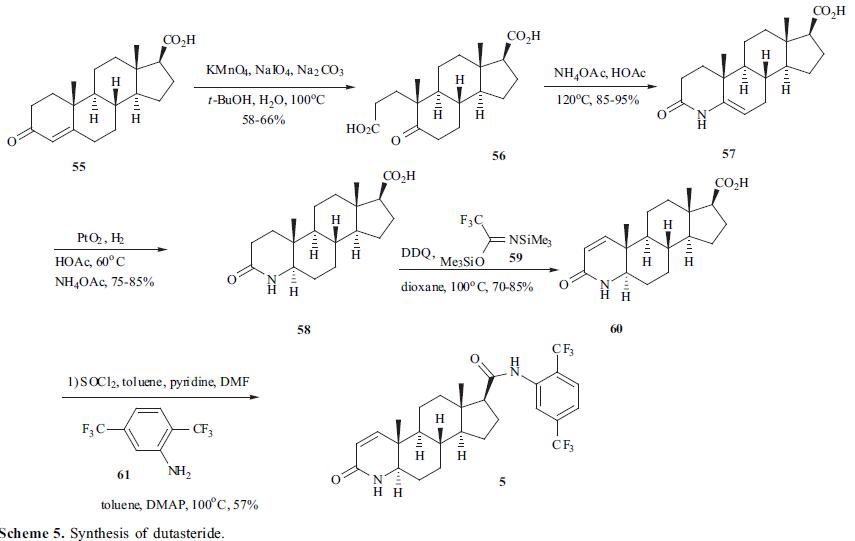
Steroidal dutasteride (5) was synthesized from 3-oxo-4-
androstene-17β-carboxylic acid (55). Oxidation of 55
with potassium permanganate, sodium periodate and sodium
carbonate in refluxing t-butyl alcohol and water gave secosteroid
56 which was cyclized with ammonium acetate in
acetic acid to give 4-aza-steroid 57 in good yield. Stereoselective
hydrogenation of 57 with H2 over PtO2 in hot
acetic acid and in the presence of ammonium acetate yielded
saturated azasteroid 58, which was dehydrogenated with
DDQ in the presence of bis(trimethylsilyl)trifluoroacetamide
(BSTFA) 59 in refluxing dioxane to give 60. Treatment of
60 with thionyl chloride gave the corresponding acyl
chloride intermediate, which was then condensed with 2,5-
bis(trifluoromethyl)aniline (61) by means of DMAP in
heated toluene to give dutasteride (5) in 57% yield from
intermediate 60.
Drug interactions
Potentially hazardous interactions with other drugs
Use with caution in combination with other
nephrotoxins.
Antivirals: avoid concomitant administration with
tenofovir
Interferons: use with caution with peginterferon alfa.
Metabolism
Adefovir is poorly absorbed orally, but the bioavailability of adefovir dipivoxil reaches approximately 59%.
The drug is absorbed to an equal extent with or without the presence of food. Adefovir is excreted renally unchanged.
References
[1] Patent: WO2010/110506, 2010, A1. Location in patent: Page/Page column 7
[2] Patent: CN105646586, 2016, A. Location in patent: Paragraph 0034; 0035; 0036; 0037; 0038; 0039; 0040-0044
[3] Patent: CN106188140, 2016, A. Location in patent: Paragraph 0019; 0020; 0021; 0022
[4] Patent: CN104387421, 2016, B. Location in patent: Paragraph 0035-0037
[5] Journal of Medicinal Chemistry, 1994, vol. 37, # 12, p. 1857 - 1864