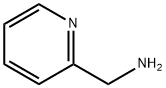
2-Picolylamine can be prepared by the following reactions: (1) Hydrocarbonation reaction In a 250 ml three-necked flask, add 11.8 g (0.084 mol) of dried hexamethylenetetramine, 100 ml of acetonitrile, and 13.7 g (90.2%, 0.076 mol) of 2-chloromethylpyridine. Stir magnetically and reflux for 8 hours. Cool to room temperature and filter to obtain a white solid. (2) Hydrolysis reaction Add the white solid obtained in the previous step to a 250 ml three-necked flask, add 34 ml of hydrochloric acid, add 100 ml of methanol while stirring, reflux at 61 °C for 2 hours and then raise the temperature to 100 °C. Cool naturally to room temperature and add 40 ml of chloroform. Add 25% NaOH aqueous solution dropwise while stirring to adjust the pH to 8~9, separate the layers, extract the aqueous layer once with chloroform, and combine the chloroform layers. Chloroform was removed under reduced pressure, yielding a yellow liquid. Upon refrigeration, it solidified into a crude 2-Picolylamine. Recrystallization from methanol yielded white crystals of 2-Picolylamine.
It is usually used as the intermediate or raw material in the organic synthesis and pharmaceutical synthesis. For example, this chemical can promote the Al(OTf)3-catalyzed aminolysis of 1,2-epoxides to produce β-Amino alcohols N-2'-pyridylmethyl in excellent yields.1 Moreover, this substance may function as the raw material to produce copper(Ⅱ) complexes with sulfonamides that act as the active chemical nucleases.2 In addition, by using this chemical as substrate, an efficient [2+3] cycloaddition approach has been developed for the synthesis of pyridyl-appended fullerene ligands.3 Besides, 2-picolylamine is chosen as the recognition group to get better selectivity for a rhodamine-based “turn-on” fluorescent probe for Fe3+ in aqueous solution.4
- Fringuelli, F.; Pizzo, F.; Tortoioli, S.; Vaccaro, L., Solvent-free Al(OTf)(3)-catalyzed aminolysis of 1,2-epoxides by 2-picolylamine: A key step in the synthesis of ionic liquids. J. Org. Chem. 2004, 69, 7745-7747.
- Macias, B.; Villa, M. V.; Salgado, M.; Borras, J.; Gonzalez-Alvarez, M.; Sanz, F., Copper(II) complexes with sulfonamides derived from 2-picolylamine and their use as chemical nucleases. Inorg. Chim. Acta 2006, 359, 1465-1472.
- Troshin, P. A.; Peregudov, A. S.; Muhlbacher, D.; Lyubovskaya, R. N., An efficient 2+3 cycloaddition approach to the synthesis of pyridyl-appended fullerene ligands. Eur. J. Org. Chem. 2005, 3064-3074.
- Ji, S. Z.; Meng, X. M.; Ye, W. P.; Feng, Y.; Sheng, H. T.; Cai, Y. L.; Liu, J. S.; Zhu, X. F.; Guo, Q. X., A rhodamine-based "turn-on" fluorescent probe for Fe3+ in aqueous solution. Dalton Trans. 2014, 43, 1583-1588.
clear colorless to yellow or orange liquid
2-Picolylamine may be used as a derivatization agent to enhance the sensitivity of carboxylic acids and short-chain fatty acids for their determination in biological samples by liquid chromatography coupled to electrospray ionization-tandem mass spectrometry (LC-ESI-MS/MS) and ultra-high performance liquid chromatography (UHPLC), respectively.
2-Picolylamine is a bihaptic amine that can be used:
- As a key precursor to synthesize various ionic liquids through the formation of β-amino alcohols as intermediates.
- As a chelating ligand for the synthesis of complexes such as zinc picolylamine complex and Cu(II) picolylamine complex.
- To functionalize poly(styrene-co-maleic anhydride) (PSMA) resin to facilitate the adsorption of uranium from aqueous solution.
ChEBI: 2-Pyridinemethanamine is a member of pyridines.
2-Picolylamine, a bihaptic nucleophile, is a bidentate ligand that is generally utilized for the preparation of various multidentate ligands and the corresponding complexes.
The initial threshold screening level (ITSL) for 2-(aminomethyl)pyridine is 0.1μg/m3 (annual averaging time).