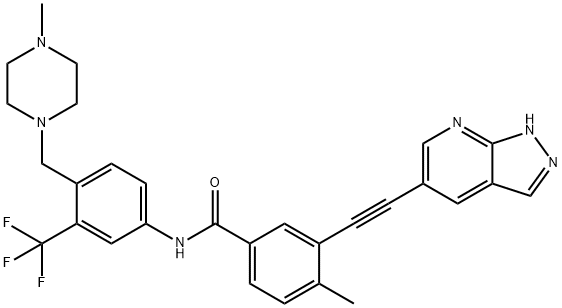
GZD-824 is an orally available inhibitor of a broad spectrum of Bcr/Abl tyrosine kinase mutants including T315I (IC50s = 0.34 and 0.68 nM for wild-type Bcr/Abl and Bcr/AblT315I, respectively). It has been shown to suppress the proliferation of Bcr/Abl-positive K562 and Ku812 human chronic myelogenous leukemia cells (IC50s = 0.2 and 0.13 nM, respectively) and induce tumor regression in mouse xenograft tumor models driven by either wild-type or mutant Bcr/Abl.
GZD824 is a orally bioavailable inhibitor that targets phosphorylated and non-phosphorylated Breakpoint Cluster Region-Abelson (Bcr-Abl) kinases. It is a COVID19-related research product.
GZD 824 (Olverembatinib), another third-generation BCR-ABL tyrosine kinase inhibitor (TKI), was approved in 2021 in China for patients with T315I positive chronic phase chronic myeloid leukemia (CML-CP) or accelerated-phase CML (CML-AP). Like ponatinib, olverembatinib inhibits multikinases, including B-RAF, DDR1, FGFR, Flt3, KIT, PDGFRα/β, RET, and SRC.
Olverembatinib is able to inhibit wild-type BCR-ABL1 kinase and a wide range of related mutants, including the T315I mutant, which makes it a potential treatment for TKI-resistant CML patients. In addition, Olverembatinib is also being studied for the treatment of acute myeloid leukemia (AML), acute lymphoblastic leukemia (ALL) and solid tumors.
Class: non-receptor tyrosine kinase
Treatment: CML
Elimination half-life = 17.5–36.5 h
In a recent patent, the synthesis of olverembatinib began with a Sonogashira coupling reaction of commercially available alkyne 24.1 with pyridinium bromide 24.2 to afford ester 24.3 in 98% yield. The N-Boc group of carbonate 24.3 was cleaved by refluxing in a mixture of MeOH and water to afford pyrazole 24.4 in 91% yield. Finally, potassium tert-butoxide-mediated amide formation with aniline 24.5 afforded olverembatinib (24) in 88% yield.

[1] XIAOMEI REN. Identification of GZD824 as an Orally Bioavailable Inhibitor That Targets Phosphorylated and Nonphosphorylated Breakpoint Cluster Region–Abelson (Bcr-Abl) Kinase and Overcomes Clinically Acquired Mutation-Induced Resistance against Imatinib[J]. Journal of Medicinal Chemistry, 2013, 56 3: 879-894. DOI:
10.1021/jm301581y