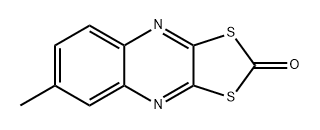
Chinomethionate is a quinoxaline fungicide and acaricide introduced in 1968 to control powdery mildew and spider mites on fruits, ornamentals, cucurbits, cotton, coffee, tea, tobacco, walnuts, vegetables and glasshouse crops. It is nonsystemic, with contact activity only.
Chinomethionate is a tan to yellow crystals. Soluble in benzene, toluene, and dioxane; insoluble in water. It has been shown to have low toxicity to mammals, birds and bees, but is highly toxic to fish and some aquatic invertebrates.
Chinomethionat exhibits both acaricidal and fungicidal activities.
It is a selective, non-systemic contact fungicide with both protective and
eradicant control of powdery mildews on fruits, cucurbits, vegetables,
ornamentals, tobacco and glasshouse crops.
ChEBI: A dithioloquinoxaline that results from the formal condensation of 6-methylquinoxaline-2,3-dithiol with phosgene. It has been used as a fungicide and acaricide for the control of mites and powdery mildew on citrus, vegetables, and walnuts, but is not appro
ed for use in the EU.
Yellow crystals. Non-corrosive. Used as a selective fungicide.
Hydrolyzed in alkaline solution.
A member of the quinoxaline, dithiolane family.
Toxic by ingestion and inhalation.
Flammability and Explosibility
Not classified
Moderately toxic by intraperitoneal, ingestion, and skin contact routes. A pesticide. When heated to decomposition it emits very toxic fumes of NOx and SOx.
Chinomethionate is synthesised from p-toluenamine as the starting material, via condensation of 6-methylquinoxaline-2,3-dithiol with phosgene, yielding a dithiol quinoxaline compound. The reaction formula is as follows:

Chemical/Physical. Reacts with ammonia forming 6-methyl-2,3-quinoxalinedithiol.
Limited information is available to describe the degradation and metabolic
fate of chinomethionat. Hydrolytic cleavage of the dithiocarbonate
ring is the primary degradation reaction in water, plants and animals.
Chinomethionat was degraded at pH 4,7 and 9 at 22 °C with DT50 values
of 10 days, 3.3 days and 3.6 hours, respectively. It is degraded under
alkaline conditions to yield 6-methyl-2,3-quinoxalinedithiol (2) (PM) as
shown in Scheme 1. Clark and Loeffler (1980) reported the extensive
photodegradation of chinomethionat in benzene in a nitrogen atmosphere
under UV light to yield dimeric condensation products and benzene
insertion products.
Chinomethionate reacts with sulfur-containing amino acids in proteins, thereby disrupting the function of many enzymes and other proteins. Because there is no single target site, target site resistance is unlikely.
Fungicide; Acaricide; Miticide; Insecticide