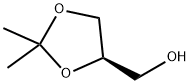
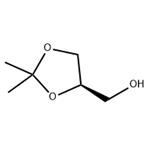
(R)-(-)-2,2-Dimethyl-1,3-dioxolane-4-methanol is a MEK inhibitor with antitumor activity.
(
R)-(-)-2,2-Dimethyl-1,3-dioxolane-4-methanol may be used to prepare:
- (R)-2,2-Dimethyl-4-benzoxymethyl-1,3-dioxolane.
- ((S)-(2,2-Dimethyl-1,3-dioxolan-4-yl)methyl 4-methylbenzenesulfonate)-1,3-dioxolane.
- (S)-Glyceraldehyde acetonide.
- Tetraoxaspiroundecanes, diglycerides, glyceryl phosphates, and spiropyrans.
Versatile trichloromethyl carbinols can be prepared in one pot from primary alcohols by treatment with Dess–Martin periodinane (DMP) in CHCl3 followed by introduction of 1,5,7-triazabicyclo[4.4.0]dec-5-ene (TBD). A modification of the method was used to convert chiral primary alcohol (R)-(-)-2,2-Dimethyl-1,3-dioxolane-4-methanol to the corresponding trichloromethyl carbinol with complete stereochemical fidelity[1].
Using anhydrous zinc chloride as the catalyst, the condensation reaction of D-mannitol with acetone to synthesize the diisopropylidene condensate was carried out under the optimal reaction conditions, with a yield of up to 65%. Subsequently, (R)-(-)-2,2-Dimethyl-1,3-dioxolane-4-methanol was obtained via chain cleavage by NaIO₄ oxidation and reduction with NaBH₄.
[1] Gupta, M. K., Li, Z., & Snowden, T. S. (2012). One-Pot Synthesis of Trichloromethyl Carbinols from Primary Alcohols. Journal of Organic Chemistry, 77 10, 4854–4860.
https://doi.org/10.1021/jo300725v