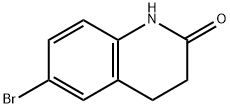
6-Bromo-3,4-dihydro-1H-quinolin-2-one is used as a precursor to react with n-BuLi and N,N-dimethylformamide[1]. It serves as a precursor to react with 2-iodopropane in the presence of NaH[2].
3,4-Dihydroquinolin-2(1H)-one (2.73 g, 18.55 mmol) was dissolved in N,N-dimethylacetamide (30 mL) and N,N-dimethylacetamide (10 mL) solution of N-bromosuccinimide (3.30 g, 18.55 mmol) was added slowly and dropwise in an ice water bath. The reaction solution continued to react in an ice water bath with stirring for 6 hours and then warmed up to room temperature for 12 hours. At the end of the reaction, water (50 mL) was added to the reaction mixture and extracted with ethyl acetate (50 mL x 3). The organic phases were combined, dried with anhydrous sodium sulfate, filtered, and concentrated under reduced pressure, and the resulting residue was purified by silica gel column chromatography (petroleum ether/ethyl acetate (v/v) = 3/1) to afford the title compound as a white solid (3.86 g, 92.1%).
[1] Moore, C., Zhu, L., & Cheng, Z. (2026). Computer–Assisted Systematic Chemical–Space Mapping of a First–in–Class Peripherally Restricted α2A AR Agonist through Scaffold–Seeded Enumeration. bioRxiv. https://doi.org/10.64898/2026.09.16.751790
[2] Chen, W., Ji, M., Cheng, H., Zheng, M., Xia, F., Min, W., Yang, H., Wang, X., Wang, L., Cao, L., Yuan, K., & Yang, P. (2022). Discovery, Optimization, and Evaluation of Selective CDK4/6 Inhibitors for the Treatment of Breast Cancer. Journal of Medicinal Chemistry, 65(22), 15102–15122. https://doi.org/10.1021/acs.jmedchem.2c00947