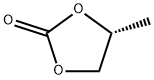
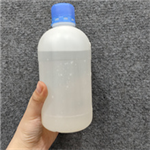
(R)-(+)-Propylene carbonate, also known as (R)-1,2-Propanediol cyclic carbonate, presents as a colorless to pale yellow liquid. This compound should keep the container tightly closed and stored in a cool and dark place. For best results, store under inert gas, protected from moisture, as this substance is moisture-sensitive. (R)-(+)-Propylene carbonate is incompatible with oxidizing agents and acids. This chemical causes skin irritation as well as serious eye irritation.
Colorless to light yellow liqui
(R)-1,2-Propylene Carbonate (cas# 16606-55-6) is a compound useful in organic synthesis.
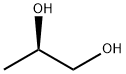
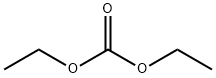
The general procedure for the synthesis of R-propylene carbonate from (R)-1,2-propanediol and diethyl carbonate was as follows: (R)-1,2-propanediol (38.05 kg, 500 mol) was added to a glass-lined reactor, followed by the addition of diethyl carbonate (70.88 kg, 600 mol) and sodium ethoxide (3.4 kg, 50 mol). The reaction mixture was heated to 105-110 °C and maintained for 8 hours. After completion of the reaction, unreacted diethyl carbonate was removed by distillation under reduced pressure. After the reaction mixture was cooled to room temperature, the insoluble material was removed by filtration. Finally, the solvent was removed by evaporation of the filtrate to afford R-propylene carbonate (34.24 kg, purity ≥99%) in 90% yield.
[1] Patent: CN105859781, 2016, A. Location in patent: Paragraph 0011-0012
[2] Patent: US2010/216822, 2010, A1. Location in patent: Page/Page column 13
[3] Tetrahedron Letters, 1998, vol. 39, # 14, p. 1853 - 1856
[4] Patent: EP1243590, 2002, A2. Location in patent: Page 9
[5] Patent: CN102977146, 2016, B. Location in patent: Paragraph 0016; 0021; 0023