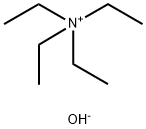
The principle of preparing tetraethylammonium hydroxide by electrolysis is as follows: Under the influence of an electric field, chloride ions in the tetraethylammonium chloride aqueous solution in the anode chamber of the electrolytic cell migrate towards the anode until they discharge and chlorine gas is released. Simultaneously, due to the selective permeability of the ion-exchange membrane, chloride ions cannot diffuse through the membrane; only tetraethylammonium ions can selectively permeate into the cathode chamber and accumulate there. In the cathode chamber, water molecules decompose into hydrogen and hydroxide ions. The latter combine with the tetraethylammonium ions that have migrated from the anode chamber to form tetraethylammonium hydroxide. As the charge increases, the concentration of tetraethylammonium hydroxide continuously increases, eventually reaching the desired crude product concentration. The anodic electrochemical reaction is: (C₂H₅)₄NCl → (C₂H₅)₄N⁺ + Cl⁻ 2Cl⁻ — 2e⁻ → Cl₂↑ The cathodic electrochemical reaction is: H₂O → H⁺ + OH⁻ (C₂H₅)₄⁺ + OH⁻ → (C₂H₅)₄OH 2H⁺ + 2e⁻ → H₂↑ The overall reaction is: 2(C₂H₅)₄NCl + 2H₂O → 2(C₂H₅)₄OH + H₂↑ + Cl₂↑ The hydrogen gas produced in the electrolysis process is released into the atmosphere, and the generated chlorine gas is absorbed by an alkaline solution to produce sodium hypochlorite, which is the main raw material for bleaching powder. Therefore, this method for preparing tetraethylammonium hydroxide is simple, has high purity, and causes no environmental pollution.
Tetraethylammonium hydroxide is a strong organic base and finds applications in photovoltaic chemicals, advanced ceramics, flat panel display chemicals, selective etching and transesterification catalysts. Its solution (35 wt. % in H2O) may be used as an organic structure-directing agent (SDA)/template in the synthesis of mesoporous molecular sieves and zeolite samples.
The product is 20wt.% solution of tetraethylammonium hydroxide (TEA hydroxide, TENOH) in H2O. TEA hydroxide is a quaternary ammonium hydroxide (QAH). It participates in the synthesis of zeolite beta. TENOH peptized titania aqueous sols have been employed in the preparation of nanocrystalline anatase films.
Strong irritant to skin and tissue.