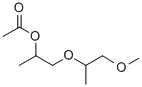
Dipropylene glycol methyl ether acetate was synthesized from dipropylene glycol methyl ether and acetic acid via an esterification dehydration method under the combined action of an acidic ionic liquid catalyst (1-butyl-3-methylimidazolium hydrogen sulfate) and a cyclohexane dehydrating agent. The catalyst dosage was 0.28% of the mass of dipropylene glycol methyl ether and acetic acid, the molar ratio of dipropylene glycol methyl ether to acetic acid was 1:13, and the esterification reaction temperature was 80-160℃. Water generated during the esterification reaction was removed by azeotropic distillation with cyclohexane. The esterification product was then purified by distillation to obtain dipropylene glycol methyl ether acetate. The distillate, containing the catalyst and a portion of the dipropylene glycol methyl ether acetate, was recycled. This method utilizes a catalyst with high activity, good stability, low corrosiveness to equipment, and the catalyst can be recycled.
Di(propylene glycol) methyl ether acetate is colorless liquid
Di(propylene glycol) methyl ether acetate is a solvent, it is also used as a formula stabilizer and to improve skin penetration in topically applied acne preparations containing erythromycin.
Di(propylene glycol) methyl ether acetate (DPMA, 3-(3-methoxypropoxy)propyl acetate) is extensively employed as a solvent in coatings and silkscreening inks. It is also used as a cleaning agent. In vivo, DPMA rapidly hydrolyzes to dipropylene glycol methyl ether (DPM), thus, the in vivo effects of DPMA are expected to be the same as those of DPM.
Flammability and Explosibility
Non flammable
The current ITSL for Dipropylene glycol methyl ether acetate is 930 μg/m3 , with annual averaging time (AT).