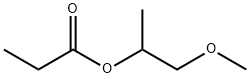
40.4 g of TiCl₄toluene was dissolved to prepare a 15% solution. Ammonia was added dropwise over 1 hour until the pH reached 9, generating Ti(OH)₄ precipitate. The precipitate was allowed to mature for 24 hours, followed by washing with water to remove chlorine. The precipitate was then dried at 110 °C for 14 hours, soaked in 0.75 mol/L H₂SO₄ for 12 hours, filtered, dried at 110 °C for 2 hours, and calcined at 450 °C for 3 hours to obtain SO₄²⁻/TiO₂ solid superacid. 200 g of propylene glycol methyl ether, 150 g of propionic acid, 5.0 g of the above catalyst, and 28 g of toluene were added to a 500 mL three-necked flask. The mixture was refluxed at 135–155 °C for 5.5 hours to obtain 324 g of crude product. GC analysis showed that the propylene glycol methyl ether propionate content was 74.6%, and the single-pass esterification rate was 81.8%.
Colorless transparent liquid
It is the most ideal solvent to directly replace ethylene glycol ethyl ether acetate, exhibiting strong dissolving power for both polar and non-polar substances. It is suitable as a solvent for various polymers in high-grade coatings and inks, including amino methyl esters, vinyl esters, polyesters, cellulose acetates, alkyd resins, acrylic resins, epoxy resins, and nitrocellulose. Among these, propylene glycol methyl ether propionate is a new generation of high-performance, green, and environmentally friendly solvent.