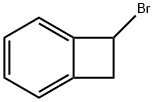
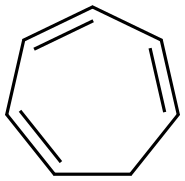
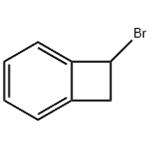
In a 250 mL round bottom flask equipped with a drying tube and condenser, cycloheptatriene (30.7 g, 300 mmol), tribromomethane (25.3 g, 100 mmol), anhydrous K2CO3 (15.0 g, 109 mmol), and 18-crown-6 (0.75 g) were added. The mixture was heated with stirring at 145°C for 9-10 hours. After completion of the reaction, the solution was allowed to cool to room temperature and diluted with an equal volume of acetone. Silica gel (15.0 g) was added to the reaction mixture and the insoluble solid residue was separated by vacuum filtration and the filter cake was washed with acetone until the washings were colorless. The filtrate was concentrated and the residual cycloheptatriene was removed by distillation. The viscous brown residue was dissolved in hot petroleum ether and the filtrate was concentrated after removing the precipitate by filtration. Vacuum distillation through a Vigreaux column gave slightly impure 1-bromobenzocyclobutene. Further purification by redistillation gave pure 1-bromobenzocyclobutene (2.95 g, 5.94% yield) as a light yellow liquid.1H NMR (300 MHz, CDCl3) δ 7.28 (m, 1H, ArH), 7.16 (d, 1H, J = 7.0 Hz, ArH), 7.07 (d, 1H, J = 6.4 Hz, ArH), 7.07 (d, 1H, J = 6.4 Hz, ArH) 5.39 (m, 1H, CH), 3.85 (dd, 1H, J = 4.4 Hz, J = 14.7 Hz, CH2), 3.45 (d, 1H, J = 14.7 Hz, CH2).