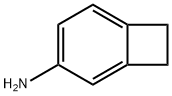
4-Aminobenzocyclobutene can be used as a starting material for the synthesis of novel BCB-functionalised monomers. It is synthesised by subjecting a siloxane containing a dianhydride to an imidisation reaction with 4-aminobenzocyclobutene. The resulting BCB monomer exhibits good solubility in common organic solvents such as ethanol, acetone and dichloromethane. They were converted into cross-linked polymers via ring-opening and the subsequent Diels–Alder reaction at an appropriate temperature. The resulting BCB polymers (BCB resins) exhibit good thermal stability, excellent dielectric properties, low water absorption and good flatness.[1]