Sodium metasilicate nonahydrate was dissolved in water to prepare a solution, which was then simultaneously added dropwise with concentrated nitric acid to deionized water at a certain temperature to form a gel. The gel was then filtered, and the filter cake was washed with deionized water until neutral. This gel was then added back to deionized water and dispersed evenly for later use. Next, magnesium nitrate hexahydrate and a mixture of sodium metasilicate nonahydrate and anhydrous sodium carbonate were separately prepared by adding them to water to prepare corresponding solutions. Both solutions were then simultaneously added dropwise to the solution from step one at a certain temperature to form a precipitate. This precipitate was then filtered, and the filter cake was washed with deionized water until neutral. The filter cake was dispersed in n-butanol, heated to dry, and most of the n-butanol and water were evaporated. The mixture was then further dried in an oven. The dried material was calcined in a muffle furnace to obtain the MgSiO composite carrier. Palladium chlorate is added to ammonia water and heated to form a tetraamminepalladium chloride solution. After ion exchange treatment with resin, a tetraamminepalladium hydroxide solution is prepared. MgSiO composite carrier is added to the tetraamminepalladium hydroxide solution from step one, mixed evenly, and then dried in an oven for a period of time at room temperature. After calcination and H2 pre-reduction treatment, the final product N-Ethyl-D-glucamine is obtained.
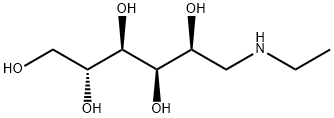
N-Ethyl-D-glucamine is an ethylated amino sugar derived from Glucose (G595000). It has low vapor pressure and good thermal stability in air, and is used in self-driven microfluidic method to pattern organic films directly in air.