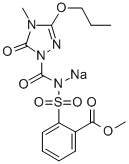
Propoxycarbazone-sodium is a post-emergence trazolone herbicide. It is highly soluble in water and mobile in soils and so has a high tendency to leach to groundwater. It is semi-volatile and is not persistent in soil. However, it is persistent in aquatic systems. It has a low oral toxicity and there are no serious human health risks reported. It is moderately toxic to birds, earthworms and fish. Its toxicity to honeybees is low.
Pure product is colorless and odorless powder crystals. m.p. 230~240℃, decomposition during melting, relative density 1.42 (20℃), vapor pressure <1×10⁻⁸Pa (20℃), partition coefficient -0.30 (pH=4.0), -1.55 (pH=7.0), -1.59 (pH=9.0). solubility at 20℃ is: dichloromethane 1.50g/L, n-heptane<0.1 g/L, xylene<0.1 g/L, isopropanol<0.1 g/L, water 42g/L (pH=7-9), 2.9g/L (pH=4.5). Stable in air at room temperature, easily degraded in soil, half-life is 9d.
Propoxycarbazone-sodium is commercially produced via a multi-step synthesis starting from 2-amino-4,6-dimethoxypyrimidine, which is sulfonylated with 2-(chlorosulfonyl)benzoic acid methyl ester in the presence of pyridine or triethylamine in dichloromethane to form the sulfonamide intermediate. This is coupled with propyl chloroformate in acetone using potassium carbonate to yield the carbamate-protected sulfonylurea precursor. Cyclisation to the triazolone ring is achieved by reaction with hydrazine hydrate in ethanol under reflux, followed by oxidation with iodine or air to close the ring and form propoxycarbazone acid. Final neutralisation with sodium hydroxide in aqueous methanol and crystallization from isopropanol-water produces propoxycarbazone-sodium.
Absorbed by leaves and roots and translocated. Inhibits plant amino acid synthesis - acetohydroxyacid synthase AHAS.