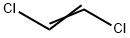
Acetylene dichloride is a colourless liquid (usually a mixture of the cis and trans isomers)
with a slightly acrid, chloroform-like odour. Acetylene dichloride is a chemical used
mainly in the production of perfumes, dyes, and thermoplastics. The type and severity
of symptoms varies depending on the amount of chemical involved and the nature of
the exposure. It is incompatible with strong oxidisers, strong alkalis, potassium hydroxide,
and copper. Acetylene dichloride is highly flammable and in a fire gives off irritating
or toxic fumes/gases. (Acetylene dichloride usually contains inhibitors to prevent
polymerisation.)
1,2-Dichloroethylene exists in three isomers,
sym-, cis-60% and trans-40%. There are variations in toxicity between these two forms. At room temperature, these
chemicals are colorless liquids with a slightly acrid, ethereal odor. The Odor Threshold in air is 17 ppm.
sym-isomer:
clear colorless to pale yellow liquid
Acetylene dichloride is a colorless liquid (usually a mixture of the cis and trans isomers)
with a slightly acrid, chloroform-like odor. It is incompatible with strong oxidizers, strong
alkalis, potassium hydroxide, and copper. Acetylene dichloride is highly flammable and
in a fi re gives off irritating or toxic fumes/gases. (Acetylene dichloride usually contains
inhibitors to prevent polymerization.)
1,2-Dichloroethylene is used as a
solvent for organic materials and as an intermediate
in the synthesis of other chlorinated
compounds; it may be produced by the chlorination
of acetylene but is often produced as a
by-product in the manufacture of other chlorinated
compounds.
A clear colorless liquid with ether-like odor. Mixture of cis and trans isomers. Flashpoint 36 - 43° F. Denser than water and insoluble in water. Vapors heavier than air.
Highly flammable. 1,2-DICHLOROETHYLENE is sensitive to air, light and moisture. Heat contributes to instability. Insoluble in water.
1,2-DICHLOROETHYLENE reacts violently with sodium, sodium hydroxide, copper and copper alloys. 1,2-DICHLOROETHYLENE can react with caustic alkynes or their concentrated solutions. 1,2-DICHLOROETHYLENE forms explosive mixtures with N2O4. 1,2-DICHLOROETHYLENE is incompatible with strong oxidizers. 1,2-DICHLOROETHYLENE is corrosive to metals. 1,2-DICHLOROETHYLENE attacks some forms of plastics, rubber and coatings.
Inhalation causes nausea, vomiting, weakness, tremor, epigastric cramps, central nervous depression. Contact with liquid causes irritation of eyes and (on prolonged contact) skin. Ingestion causes slight depression to deep narcosis.
Exposures to acetylene dichloride cause irritation to the eyes, respiratory system, and CNS
depression with symptoms of cough, sore throat, dizziness, nausea, drowsiness, weakness,
unconsciousness, and vomiting. It involves the eyes, respiratory system, and the CNS
as the target organs. Prolonged periods of exposure to acetylene dichloride defats the skin
and may have effects on the liver.
Reactivity with Water No reaction; Reactivity with Common Materials: No reaction; Stability During Transport: Stable; Neutralizing Agents for Acids and Caustics: Not pertinent; Polymerization: Will not occur under ordinary conditions of shipment. The reaction is not vigorous; Inhibitor of Polymerization: None used.
Poison by inhalation.
Moderately toxic by ingestion. A skin
irritant. When heated to decomposition it
emits highly toxic fumes of Cl-. See also
ACETYLENE COMPOUNDS, and
CHLORINATED HYDROCARBONS,
ALIPHATIC .
Primary irritant (w/o allergic reaction).
1,2-Dichloroethylene is used as a solvent for waxes, resins,
and acetylcellulose. It is also used in the extraction of rubber, as a refrigerant; in the manufacture of pharmaceuticals
and artificial pearls; and in the extraction of oils and fats
from fish and meat.
If this chemical gets into the eyes, remove anycontact lenses at once and irrigate immediately for at least15 min, occasionally lifting upper and lower lids. Seek medical attention immediately. If this chemical contacts theskin, remove contaminated clothing and wash immediatelywith soap and water. Seek medical attention immediately. Ifthis chemical has been inhaled, remove from exposure,begin rescue breathing (using universal precautions, including resuscitation mask) if breathing has stopped and CPR ifheart action has stopped. Transfer promptly to a medicalfacility. When this chemical has been swallowed, get medical attention. Give large quantities of water and inducevomiting. Do not make an unconscious person vomit.
In genotoxic assays the cis isomer induced
chromosomal aberrations in mouse bone
marrow cells after intraperitoneal injections.7
Neither isomer was mutagenic in bacterial
assays, nor did they produce chromosomal
aberrations or sister chromatid exchanges in
mammalian cells in vitro.
The 2003 ACGIH threshold limit valuetime-
weighted average (TLV-TWA) for 1,2-
dichloroethylene is 200ppm (793mg/m3).
Color Code—Red: Flammability Hazard: Store ina flammable liquid storage area or approved cabinet awayfrom ignition sources and corrosive and reactive materials.Prior to working with 1,2-DCE you should be trained on itsproper handling and storage. Before entering confined spacewhere this chemical may be present, check to make surethat an explosive concentration does not exist. 1,2-Dichloroethylene must be stored to avoid contact withstrong oxidizers (such as chlorine, bromine, and fluorine)since violent reactions occur. Store in tightly closed containers in a cool, well-ventilated area away from heat.Sources of ignition, such as smoking and open flames, areprohibited where 1,2-dichloroethylene is used, handled, orstored. Metal containers involving the transfer of=gallonsor more of 1,2-dichloroethylene should be grounded andbonded. Drums must be equipped with self-closing valves,pressure vacuum bungs, and flame arresters. Use only nonsparking tools and equipment, especially when opening andclosing containers of 1,2-dichloroethylene. Wherever 1,2-dichloroethylene is used, handled, manufactured, or stored,use explosion-proof electrical equipment and fittings.
UN1150 Dichloroethylene, Hazard Class: 3;
Labels: 3-Flammable liquid.
Shake it successively with conc H2SO4, water, aqueous NaHCO3 and water. Dry it with MgSO4 and fractionally distil it to separate the cis-and trans-isomers. [Beilstein 1 IV 707-709.]
May form explosive mixture with air.
Attacks some plastics, rubber, and coatings. Incompatible
with oxidizers (chlorates, nitrates, peroxides, permanganates, perchlorates, chlorine, bromine, fluorine, etc.);
contact may cause fires or explosions. Keep away from
alkaline materials, strong bases, strong acids, oxoacids, and
epoxides. Gradual decomposition results in hydrochloric
acid formation in the presence of ultraviolet light or upon
contact with hot metal or other hot surfaces. Reacts with
strong bases; potassium hydroxide; difluoromethylene,
dihypofluoride, nitrogen tetroxide (explosive); or copper
(and its alloys) producing toxic chloroacetylene which is
spontaneously flammable on contact with air. Attacks some
plastics and coatings.
The Initial Threshold Screening Level (ITSL) for 1,2-dichioroethylene is 18 μg/m3 with annual averaging time.
Incineration, preferably after
mixing with another combustible fuel. Care must be exercised to assure complete combustion to prevent the formation of phosgene. An acid scrubber is necessary to remove
the halo acids produced. Consult with environmental
regulatory agencies for guidance on acceptable disposal
practices. Generators of waste containing this contaminant
(≧100 kg/mo) must conform with EPA regulations governing storage, transportation, treatment, and waste disposal.