Description
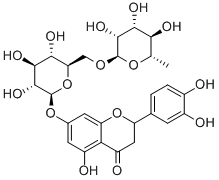
Eriocitrin is a flavonoid originally isolated from lemon peel that has antioxidant and enzyme inhibitory activity. Eriocitrin inhibits lipid peroxidation in a cell-free assay when used at a concentration of 10 μM and enhances the effect of α-tocopherol on lipid peroxidation. It also decreases thiobarbituric acid reactive substances (TBARS) in rat plasma when administered at a dose of 75 μmol/kg, indicating a reduction in lipid peroxidation. Eriocitrin prevents acute exercise-induced increases in TBARS, N
ε-(hexanoyl)lysine (HEL),
o,o-dityrosine (DT), and nitrotyrosine (NT; ) in rat liver when administered at a dose of 600 mg/kg prior to exercise. It is also an inhibitor of monoamine oxidase A (MAO-A) and MAO-B (IC
50s = 86.5 and 164 μM, respectively, for human recombinant receptors).
References
[1] ROBERT M. HOROWITZ Bruno G. Flavonoid Compounds of Citrus. III. Isolation and Structure of Eriodictyol Glycoside[J]. Journal of the American Chemical Society, 1960, 82 11: 2803-2806. DOI:
10.1021/ja01496a033[2] Y. MIYAKE T O Kanefumi Yamamoto. Isolation of eriocitrin (eriodictyol 7-rutinoside) from lemon fruit (Citrus limon Burm. f.) and its antioxidative activity[J]. Food Science and Technology International, Tokyo, 1997, 1 1: 84-89. DOI:
10.3136/fsti9596t9798.3.84[3] YOSHIAKI MIYAKE. Identification and Antioxidant Activity of Flavonoid Metabolites in Plasma and Urine of Eriocitrin-Treated Rats[J]. Journal of Agricultural and Food Chemistry, 2000, 48 8: 3217-3224. DOI:
10.1021/jf990994g[4] KEN-ICHIRO MINATO . Lemon flavonoid, eriocitrin, suppresses exercise-induced oxidative damage in rat liver[J]. Life sciences, 2003, 72 14: Pages 1609-1616. DOI:
10.1016/s0024-3205(02)02443-8[5] SIMONE CARRADORI*. Inhibition of Human Monoamine Oxidase: Biological and Molecular Modeling Studies on Selected Natural Flavonoids[J]. Journal of Agricultural and Food Chemistry, 2016, 64 47: 9004-9011. DOI:
10.1021/acs.jafc.6b03529