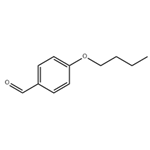
Chemical Properties
CLEAR YELLOW TO ORANG-RED LIQUID
Uses
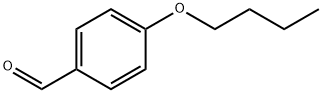
4-Butoxybenzaldehyde has been used in the synthesis of:
- 6-amino-4-(4-butoxyphenyl)-3,5-dicyanopyridine-2(1H)-thione
- 16-(p-butoxybenzylidene)androsta-1,4-diene-3,17-dione via condensation reaction with androsta-1,4-diene-3,17-dione
Synthesis Reference(s)
The Journal of Organic Chemistry, 66, p. 2966, 2001
DOI: 10.1021/jo0056848
General Description
Kinetic constant for the inhibition of the diphenolase activity of mushroom tyrosinase by 4-butoxybenzaldehyde has been evaluated.
Synthesis
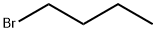
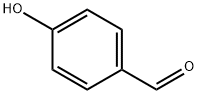
In a 100 mL round-bottomed flask equipped with a reflux condenser tube and a magnetic stirrer, p-hydroxybenzaldehyde (35 g, 287 mmol) and 1-bromobutane (30.92 mL, 287 mmol) were dissolved in N,N-dimethylformamide (DMF, 750 mL). The reaction mixture was stirred for 20 min under nitrogen protection. Subsequently, anhydrous potassium carbonate (118.83 g, 860 mmol) was added and the reaction was continued to be stirred at 70 °C for 20 hours. After completion of the reaction, the mixture was cooled to room temperature. The reaction was quenched with excess water and extracted with ethyl acetate. The organic phases were combined, washed several times with water, dried over anhydrous sodium sulfate and filtered. The crude product was purified by silica gel column chromatography (petroleum ether/ethyl acetate, 20:1) to afford the brown oily target product 4-butoxybenzaldehyde. Yield: 95%; 1H NMR (500 MHz, CDCl3) δH (ppm): 9.89 (s, 1H), 7.84 (d, J = 8.8 Hz, 2H), 7.00 (d, J = 8.6 Hz, 2H), 4.06 (t, J = 6.3 Hz, 2H), 1.79-1.85 (m, 2H), 1.49-1.57 (m. 2H), 1.01 (t, J = 7.3 Hz, 3H); 13C NMR (125 MHz, CDCl3) δC (ppm): 190.7, 164.2, 131.9, 129.8, 114.7, 68.1, 31.0, 19.1, 13.7; ESI-MS: m/z 179.2 ([M + H]+). The following alkoxybenzaldehyde derivatives 4b-h were synthesized by a similar method.
References
[1] Journal of the American Chemical Society, 2014, vol. 136, # 46, p. 16399 - 16410
[2] Journal of the American Chemical Society, 2010, vol. 132, # 39, p. 13675 - 13683
[3] European Journal of Medicinal Chemistry, 2017, vol. 130, p. 286 - 307
[4] Synthetic Communications, 2001, vol. 31, # 21, p. 3323 - 3328
[5] Patent: CN107556333, 2018, A. Location in patent: Paragraph 0076-0079