Chemical Properties
Red Solid
Usage
An aldose reductase inhibitor. It is used in treatment of diabetic neuropathy.
Usage
Epalrestat is an aldose reductase inhibitor with IC50 of 72 nM
Description
Epalrestat is the second aldose reductase inhibitor to be introduced worldwide and the
first to be launched in Japan. The compound is indicated for the treatment of diabetic
neuropathy. It is also being investigated for diabetic retinopathy and nephropathy.
Uses
An aldose reductase inhibitor. It is used in treatment of diabetic neuropathy.
Uses
Epalrestat is an aldose reductase inhibitor with IC50 of 72 nM
Definition
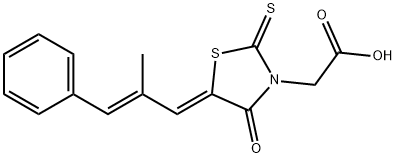
ChEBI: A monocarboxylic acid that is 1,3-thiazolidine which is substituted on the nitrogen by a carboxymethyl group, at positions 2 and 4 by thioxo and oxo groups, respectively, and at position 5 by a 2-methyl-3-phenylprop-2-en-1-ylidene group. It is an inhibitor
of aldose reductase (which catalyses the conversion of glucose to sorbitol) and is used for the treatment of some diabetic complications, including neuropathy.
Biochem/physiol Actions
Epalrestat inhibits Aldose Reductase (AR) involved in the rate limiting step in the conversion of glucose to sorbitol under hyperglycemic conditions. Aldose reductase has been the target of multiple clinical investigatons to treat diabetic neuropathy and retinopathy. Epalrestat is an approved drug in Japan and India, used for the treatment of diabetic neuropathy.
Synthesis
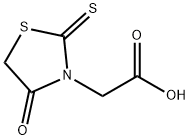
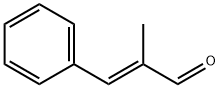
General procedure for the synthesis of the compound (CAS:82158-86-9) from 3-carboxymethyl bypassed tannin and trans-α-methyl cinnamaldehyde: Rhodanine-3-acetic acid (131.0 g) was dissolved in 700 mL of N,N-dimethylformamide (DMF), followed by a slow addition to the reaction mixture at 25-35°C of (E)-2-methyl-3-phenyl Acrolein (100.0 g) and 200 mL of DMF. next, a solution of ammonium acetate (63.27 g) dissolved in 60 mL of water was added to the reaction system, maintained at a temperature of 30-35°C and stirred for 4 hours. Upon completion of the reaction, the reaction mixture was cooled to 10-15°C. At this temperature, concentrated hydrochloric acid (100.0 g) was slowly added and the reaction temperature was maintained at 10-15°C for 2 hours. At the end of the reaction, the reaction mixture was filtered and the solid product was washed with DMF. Finally, the product was dried by rotary evaporation for 2-4 hours to give 2-((Z)-5-((E)-2-methyl-3-phenylpropenyl)-4-oxo-2-thioxothiazolidin-3-yl)acetic acid in the yield of 260.50 g. The reaction was carried out at a temperature of 10-15°C for 2 hours.
References
1) Kikkawa?et al. (1983)?Effect of a new aldose reductase inhibitor, (E)-3-carboxymethyl-5-[(2E)-methyl-3-phenylpropenylidene]rhodanine (ONO-2235), on peripheral nerve disorders in streptozotocin diabetic rats; Diabetologica,?24?290
2) Terashima?et al. (1984)?Effects of a new aldose reductase inhibitor on various tissues in vitro; J. Pharmacol. Exp. Ther.,?229?226
3) Ramirez and Borja (2008)?Epalrestat: an aldose reductase inhibitor for the treatment of diabetic neuropathy; Pharmacotherapy,?28?646