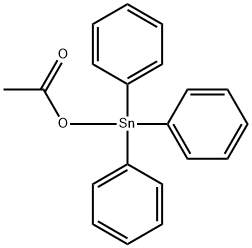
General Description
A white crystalline solid. Melting point 123-131°C (253-268°F). Used as a fungicide, algaecide and molluscicide. Controls early and late blight on potatoes.
Reactivity Profile
ACETOXYTRIPHENYLSTANNANE is subject to decomposition when exposed to air, light and moisture [EPA, 1998].
Air & Water Reactions
Slowly oxidized, hydrolyzed when exposed to air and moisture.
Health Hazard
Very toxic, irritant to skin.
Fire Hazard
Avoid air, light and moisture.
Description
Fentin acetate is an obsolete organotin fungicide. It has a low aqueous solubility and low volatility. Evidence suggests it is quite persistent in soil systems but less so in aquatic systems. Based on its physico-chemical properties it is not expected to leach to groundwater. Ecotoxicological data is limited but acute oral ecotoxicity tends to be high. It is moderately toxic to mammals via the oral route.
Chemical Properties
The pure product is white crystals, odorless. Its mp is 118-122°C, vapor pressure is 0.177×10⁻³ Pa (30°C), and relative density is 1.55. It is slightly soluble in most organic solvents, with a solubility of 28 mg/L in water. It is stable in a dry place but readily decomposes in air and sunlight, eventually forming water-soluble tin compounds. The purity of the commercial product is 90%-95%.
Uses
Fentin is a non-systemic fungicide with protective and curative
action. It is used to control early and late blight in potatoes and a range of
diseases in vegetables, sugar beet, peanuts, wheat, coffee, cocoa and
pecans. It is also used to control algae and snails in rice fields. Fentin has
previously been used as an antifoulant in marine paint.
Uses
Triphenyltin Acetate is an organotin compound. Triphenyltin Acetate much like its hydroxide analogue is used as a fungicide and antifeeding compound for insect control. Recent studies show that Triphenyltin Acetate may have adverse effects on the reproductive and immune systems and may disrupt the endocrine system.
Definition
ChEBI: An organotin compound that is the O-acetyl derivative of triphenyltin hydroxide. A fungicide used to control blights on potatoes, leaf spot diseases on sugar beet and anthracnose on beans.
Production Methods
Fentin acetate is commercially produced by esterifying triphenyltin hydroxide with acetic acid or acetic anhydride. The synthesis begins with the preparation of triphenyltin hydroxide, typically derived from triphenyltin chloride via hydrolysis. This intermediate is then reacted with acetic anhydride or glacial acetic acid under controlled conditions to form fentin acetate. The reaction is usually carried out in an organic solvent such as toluene or xylene, with careful temperature regulation to ensure complete esterification and minimise byproducts.
Mechanism of action
Non-systemic with predominate contact activity. Inhibitor of mitochondrial ATP synthase.
Metabolic pathway
Fentin is degraded in soil and other biological media to give inorganic tin
via the di- and mono-phenyltin compounds; often the resulting benzene is
liberated. An extensive review on the metabolism and fate and behaviour
of triphenyltin and its degradation products was published by Bock
(1981). Fentin hydroxide has been the subject of an evaluation by the
Pesticide Safety Directorate of UK MAFF (PSD, 1990).
Degradation
Fentin acetate is stable when dry but easily hydrolysed to fentin hydroxide
in the presence of water. It is unstable in acids and alkalis (DT50 <3
hours at pH 5, 7 or 9; 22 °C) and ionises to the triphenyltin cation. Triphenyltin
compounds are converted rapidly and quantitatively into the
hydroxide by alkali. Diphenyltin compounds (2) (see Scheme 1) react
similarly but the hydroxide quickly loses water forming the oxide.
Diphenyltin chloride initially hydrolyses to (C6H5),Sn(OH)Cl which
forms compound 3 when dissociated and then the oxide is formed via
dimeric intermediates. Diphenyltin compounds also split off phenyl
groups as benzene (4) under the influence of water, acids or bases.
Monophenyltin compounds (5) are also converted by alkali into the
hydroxide which immediately loses water to form phenylstannonic acid
(C6H5SnOOH) (6). In aqueous solution and at room temperature, triphenyltin
compounds decompose at a slow rate, losing phenyl groups as
benzene. The acetate is decomposed by sunlight and atmospheric oxygen.
Phenyltin compounds are slowly decomposed by sunlight and more
rapidly by UV light to give inorganic tin via the di- and mono-phenyltin
compounds (PM; Bock, 1981).
Pesticide Type
Fungicide; Molluscicide; Algicide