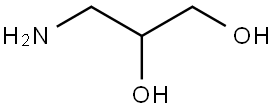
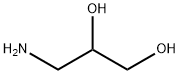
Description
APD is a calcium metabolism regulator useful in the treatment of Paget's disease,
tumor-induced hypercalcemia and other bone disorders involving increased osteoclastic
activity.
Chemical Properties
clear colorless to pale yellow viscous liquid
Originator
Henkel (W. Germany)
Application
(±)-3-Amino-1,2-propanediol is used as a reactant in the synthesis of lipid-like delivery molecules(lipidoids) for RNA interference (RNAi) therapeutics. It is also used in the synthesis of the bioactive template to prepare cationic α-helical polypeptides and various cationic polymers for gene delivery.
Uses
3-Amino-1,2-propanediol is used in the preparation of iohexol, which is a X-CT non-ionic contrast medium. It acts as a starting material in the production of specialty materials.
Preparation
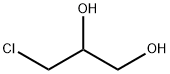
3-Amino-1,2-propanediol is synthesized by reacting 3-chloro-1,2-propanediol (CPD) with ammonia in alkaline environment by adding sodium hydroxide. Afterwards, the product undergoes a series of purification steps.
General Description
3-Amino-1,2-propanediol is a chiral glycerol derivative. It could used as a hydrogen bond donor in the design of a new deep eutectic solvent which have emerged as a suitable alternative to VOCs (volatile organic compounds) for diverse practical applications including, among others, drug delivery, electrochemistry, material design, extractions and, of course, organic reactions, alone or together twith other sustainable reaction-media[1]. It can also used as a core present in antiviral compounds to skeleton to design a novel class of anti-adenovirus agents[2].
Hazard
3-Amino-1,2-propanediol is Danger.
H314 (93.33%): Causes severe skin burns and eye damage [Danger Skin corrosion/irritation]
H318 (56.36%): Causes serious eye damage [Danger Serious eye damage/eye irritation]
Materials Uses
Chloromethylated polystyrene resin was modified by 3-amino-1,2-propanediol to obtain dihydroxyamine resin (KLA resin); Using trometamol as a raw material, chloromethylated polystyrene resin was modified to prepare polyhydroxyamine resin (KDN resin)[3].
Safety Profile
Poison by intraperitoneal route.Moderately toxic by ingestion. When heated todecomposition it emits toxic fumes of NOx.
Synthesis
The synthesis of 3-amino-1,2-propanediol (APD) was carried out in a microreactor using 3-chloro-1,2-propanediol (1-CPD, 99% purity, aqueous solution, flow rate of 3.0 mL/min) as raw material. The reaction system was simultaneously injected with NaOH solution (10% concentration, flow rate 11.6 mL/min) and NH3 solution (25% concentration, flow rate 56.4 mL/min). The reaction process was divided into two phases: the first phase was carried out in the first and second reaction chambers with a residence time of 2.87 min, which mainly produced glycidol; the second phase was carried out in the fourth to tenth reaction chambers with a residence time of 21.1 min, which completed the ammonolysis reaction. The total residence time was 23.98 minutes. The reaction temperature was controlled at 42°C for the first stage and 18°C for the second stage. The products were collected in a Teflon tube collection component at ambient temperature (~22°C). Samples were taken 50 minutes from the start of the reaction, and the yield of APD was 67.4% (% area) based on the 1-CPD feed.
storage
3-Amino-1,2-propanediol absorbs moisture and needs to be kept in a container sealed. Store in cool, dry conditions in well-sealed containers.
References
[1] Antenucci A, et al. Design of a New Chiral Deep Eutectic Solvent Based on 3-Amino-1,2-propanediol and Its Application in Organolithium Chemistry. Molecules, 2022; 27.
[2] Mazzotta S, et al. Design, synthesis and in vitro biological evaluation of a novel class of anti-adenovirus agents based on 3-amino-1,2-propanediol. Bioorganic Chemistry, 2021; 114: 105095.