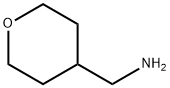
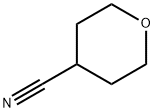
Example 43 (Synthesis of 4-aminomethyltetrahydropyran): In a 200 mL stainless steel autoclave equipped with a stirring device, a thermometer, and a manometer, 10.0 g (90.0 mmol) of 4-cyanotetrahydropyran, 50.0 g of a 22% (w/w) ammonia-methanol solution, and 2.0 g (17.0 mmol as nickel atoms) of activated Raney nickel ( provided by Nikki Chemical Co., Ltd; nickel sponge N154D). The reaction was stirred under hydrogen atmosphere at 45 to 55 °C and 0.51 to 0.61 MPa pressure for 17 hours. After completion of the reaction, the insoluble material was removed by filtration and the filtrate was washed with 30 mL of methanol. The filtrate and washings were combined, concentrated under reduced pressure and then distilled under reduced pressure at 73-74 °C and 2.67 kPa to give 7.94 g (76.6% isolated yield) of 4-aminomethyltetrahydropyran as a colorless liquid. Its physical properties were as follows: 1H-NMR (DMSO-d6, δ (ppm)): 1.02-1.16 (2H, m), 1.10-1.50 (2H, brs), 1.34-1.45 (1H, m), 1.56-1.61 (2H, m), 2.39 (2H, d, J = 6.3 Hz), 3.20-3.29 (2H, m ), 3.81-3.86 (2H, m); CI-MS (m/e): 116 (M+1), 99.
Example 45 (Synthesis of 4-aminomethyltetrahydropyran): in a 200 mL stainless steel autoclave equipped with a stirring device, a thermometer, and a manometer, 10.0 g (90.0 mmol) of 4-cyanotetrahydropyran, 100 mL of a 22% (w/w) ammonia-methanol solution, and 2.0 g (17.0 mmol as nickel atoms) of activated Raney nickel ( provided by Nikki Chemical Co., Ltd; nickel sponge N154D). The reaction was stirred under hydrogen atmosphere at 50 to 60 °C and 0.51 to 0.61 MPa pressure for 5 hours. After completion of the reaction, the insoluble material was removed by filtration and the filtrate was washed with 30 mL of methanol. The filtrate and washings were combined and analyzed by gas chromatography (internal standard method) to confirm the formation of 8.84 g (85.3% reaction yield) of 4-aminomethyltetrahydropyran and no by-product bis(4-tetrahydropyranosylmethyl)amine was detected.