Uses
Rimsulfuron is used as a pesticide.
Definition
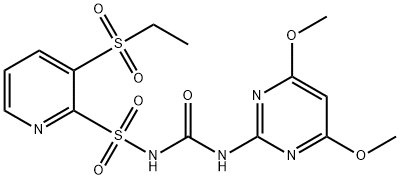
ChEBI: A N-sulfonylurea that is N-carbamoyl-3-(ethylsulfonyl)pyridine-2-sulfonamide substituted by a 4,6-dimethoxypyrimidin-2-yl group at the amino nitrogen atom.
Production Methods
Rimsulfuron is commercially produced via a convergent multi-step synthesis: the sulfonamide intermediate N-[(4,6-dimethoxypyrimidin-2-yl)aminocarbonyl]-2-(ethylsulfonyl)pyridine-3-sulfonamide is formed by coupling 2-amino-4,6-dimethoxypyrimidine with 2-(ethylsulfonyl)pyridine-3-sulfonyl isocyanate (generated from 2-(ethylthio)pyridine-3-sulfonamide via phosgene or triphosgene activation followed by oxidation with hydrogen peroxide); subsequent condensation with dimethylamine or direct amination yields the active substance.
Agricultural Uses
Herbicide: For controlling broadleaf weeds. Registered for use in the U.S. and Canada. A U.S. EPA restricted Use Pesticide (RUP) for some formulations. Registered for use in some EU countries.
Trade name
ACCENT®; BASIS® (rimsulfuron+thifensulfuron methyl); DPX-E9636®; DPX 79406® (nicosulfuron+rimsulfuron); Matrix® (nicosulfuron+rimsulfuron); SHADEOUT®; STEADFAST®, (nicosulfuron+rimsulfuron); TRANXIT®
Mechanism of action
Selective, systemic, absorbed through foliage and roots and translocated.Inhibits plant amino acid synthesis - acetohydroxyacid synthase AHAS
Metabolic pathway
The primary degradation pathway in most of the
systems examined is the contraction or
rearrangement and hydrolysis of the sulfonylurea
linkage to yield two products that have N-pyridyl-N-
pyrimidyl urea and N-pyridyl-N-pyrimidylamine
moieties, and fragments of pyridine sulfonamide, 4,6-
dimethoxy-2-pyrimidylurea, and 4,6-dimethoxy-2-
amino-pyrimidine, respectively. In plants,
demethylation and hydroxylation reactions follow the contraction or rearrangement to give N-3,4-dihydroxy-
5-methoxy-2-pyrimidyl-N(3-ethylsulfonyl-2-
pyridyl)amine.