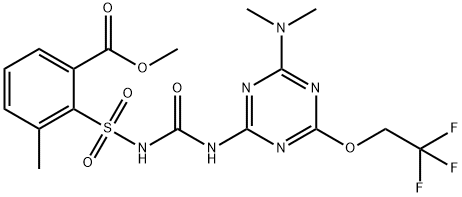
Description
Triflusulfuron-methyl is a s ulfonylurea herbicide. It is moderately soluble in water and has a low volatility. It is not expected to be persistent in soil systems but may be persistent in water depending on local conditions. It is not expected to leach to groundwater. Whilst its toxicity to aquatic plants is high, toxicity to most other species is moderate to low. Triflusulfuron-methyl has a low oral mammalian toxicity and is thought to be a respiratory tract irritant. It is possible that this substance is carcinogenic.
Chemical Properties
This product has an mp of 160-163°C and a dissociation constant (pKa) of 4.4. Its solubility in water at 25°C is 1 mg/L (pH=3), 3 mg/L (pH=5), 110 mg/L (pH=7), and 11,000 mg/L (pH=9). Its partition coefficient is 9.2. Its half-life in water at 25°C is 3.7 days (pH=5), 32 days (pH=7), and 36 days (pH=9). It degrades rapidly in soil, primarily through microbial degradation under alkaline conditions and chemical hydrolysis under neutral and acidic conditions. Under laboratory conditions, its half-life in soil is 3-6 days.
Definition
ChEBI: Triflusulfuron-methyl is a methyl ester resulting from the formal condensation of the carboxy group of triflusulfuron with methanol. A proherbicide for triflusulfuron. It has a role as a proherbicide, an agrochemical and an EC 2.2.1.6 (acetolactate synthase) inhibitor. It is a benzoate ester, a methyl ester, a N-sulfonylurea, a member of 1,3,5-triazines, a tertiary amino compound, an aromatic ether and an organofluorine compound. It is functionally related to a triflusulfuron.
Production Methods
In industrial settings, the synthesis of triflusulfuron-methyl begins with the preparation of a triazine ring system, typically derived from cyanuric chloride, which undergoes sequential substitution with fluorinated aromatic amines and methoxy groups. This intermediate is then reacted with a sulfonyl isocyanate or sulfonamide to form the characteristic sulfonylurea bridge, a key functional group responsible for herbicidal activity. The process requires precise control of temperature, solvent conditions, and pH to ensure high purity and yield.
Mechanism of action
Inhibits acetolactate synthase (ALS), an enzyme essential for amino acid synthesis in plants