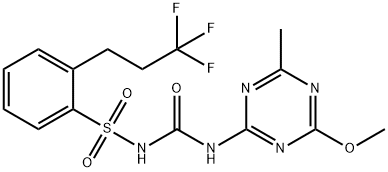
Description
Prosulfuron is a broad-spectrum herbicide. It is highly soluble in water and many organic solvents, is volatile, mobile and has a high potential for leaching to groundwater. It is generally moderately persistent in soil systems but can be very persistent in aquatic systems. It is moderately toxic to mammals but is not expected to bioaccumulate. It is moderately toxic to birds, honeybees, earthworms and fish but less so to aquatic invertebrates. It is highly toxic to algae and aquatic plants.
Chemical Properties
Flusulfuron pure product is colorless and odorless crystal, purity ≥95%. Melting point 155°C (decomposition). Vapor pressure≤3.5×10⁻³mPa(25℃). Distribution coefficient Kow lg(25℃);1.5(pH 5.0),-0.21(pH 6.9),-0.76(pH 9.0).Henry value<3×10⁻⁴Pa -m3/ mol.Solubility in water(25℃ , mg/L):distilled water29(pH4.5),buffer solution:87(pH 5.0),4000(pH 6.8),43000(pH 6.8). 6.8), 43000 (pH 7.7). Solubility in organic solvents (25°C,g/L):ethanol 8.4, acetone 160, toluene 6.1, n-hexane 0.0064, n-octanol 1.4, ethyl acetate 56, dichloromethane 180.Stability:Rapidly hydrolyzable, DT505~10d(pH 5),>ly(pH 7,9)(both at 20°C). Stable to light, pKa3.76.
Definition
ChEBI: Prosulfuron is a member of triazines.
Agricultural Uses
Herbicide: Used as a post-emergence herbicide on corn and cereals such as barley, millet, oats, rye, sorghum and wheat. Used on sugar cane in some countries. Currently registered in some EU countries. Registered for use in the U.S.
Trade name
CGA®-152005; EXCEED®; PEAK®; SPIRIT®
Mechanism of action
Absorbed by leaves and roots. Inhibits plant amino acid synthesis - acetohydroxyacid synthase AHAS
Synthesis
Synthetic route for Prosulfuron intermediate by Ciba-Geigy/Novartis.[1]

Metabolic pathway
As shown below, the degradation profiles of
prosulfuron by hydrolysis, mammal, soil
microorganism, plant, plant microsome, and soil are well investigated. In addition to the degradation
products derived by the common cleavage reaction of
the sulfonylurea linkage, the predominant
hydroxylation reaction occurs on the phenyl ring and
the trifluoropropyl side chain by mammal and soil
microorganisms, resulting in the formation of the
hydroxylated metabolites which mostly retain the
sulfonylurea moiety in the structures.