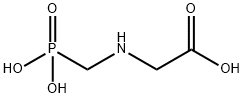
Chemical Properties
Glyphosate is a broad-spectrum, non-selective systemic herbicide. It is a colorless crystal at room temperature and is soluble in acetone, ethanol, xylene, and water. Glyphosate is used for the control of annual and perennial plants, including grasses, sedges, broadleaved weeds, and woody plants. It can be used on non-cropland as well as on many varieties of crops. Glyphosate itself is an acid, but it is commonly used in salt form, most commonly isopropylamine salt. It may also be available in acidic or trimethylsulfonium salt forms. It is generally distributed as water-soluble concentrates and powders. Glyphosate is a GUP.
General Description
Odorless white powder. Decomposition begins at approximately 419°F (darkens). pH (1% solution in water) 2.5.
Reactivity Profile
GLYPHOSATE(1071-83-6) may react with galvanized steel or unlined steel (except stainless steel) containers to produce hydrogen gas which may form a highly combustible or explosive gas mixture. GLYPHOSATE(1071-83-6) can react with caustic (basic) materials to liberate heat. GLYPHOSATE(1071-83-6) is corrosive to iron.
Air & Water Reactions
Slightly water soluble.
Health Hazard
Glyphosate is practically non-toxic if ingested, with a reported acute oral LD50 of 5600 mg/kg in the rat. The toxicities of the technical acid (glyphosate) and the formulated product (Roundup) are nearly the same. Laboratory animals, such as rats, dogs, mice, and rabbits, exposed to glyphosate for 2 years did not indicate any kind of adverse health effects.
Potential Exposure
A potential danger to those involved
in the manufacture, formulation, and application of this
nonselective and nonresidual pre-emergence organophos phate herbicide. Has wide residential use in the United
States for the control of weeds.
Fire Hazard
Flash point data for this chemical are not available; however, GLYPHOSATE is probably combustible.
First aid
If this chemical gets into the eyes, remove any
contact lenses at once and irrigate immediately for at least
15 minutes, occasionally lifting upper and lower lids. Seek
medical attention immediately. If this chemical contacts the
skin, remove contaminated clothing and wash immediately
with soap and water. Speed in removing material from skin
is of extreme importance. Shampoo hair promptly if con taminated. Seek medical attention immediately. If this
chemical has been inhaled, remove from exposure, begin
rescue breathing (using universal precautions, including
resuscitation mask) if breathing has stopped and CPR if
heart action has stopped. Transfer promptly to a medical
facility. When this chemical has been swallowed, get medi cal attention. Give large quantities of water and induce
vomiting. Do not make an unconscious person vomit.
Shipping
UN3077 Environmentally hazardous substances,
solid, n.o.s., Hazard class: 9; Labels: 9-Miscellaneous haz ardous material, Technical Name Required.
Incompatibilities
Organophosphates are susceptible to for mation of highly toxic and flammable phosphine gas in the
presence of strong reducing agents such as hydrides. Partial
oxidation by oxidizing agents may result in the release of
toxic phosphorus oxides. Compounds of the carboxyl
group react with all bases, both inorganic and organic (i.e.,
amines) releasing substantial heat, water, and a salt that
may be harmful. Incompatible with arsenic compounds
(releases hydrogen cyanide gas), diazo compounds, dithio carbamates, isocyanates, mercaptans, nitrides, sulfides
(releasing heat, toxic, and possibly flammable gases), thio sulfates, and dithionites (releasing hydrogen sulfate and
oxides of sulfur). Solutions are corrosive to iron, unlined
steel, and galvanized steel, forming a highly combustible or
explosive gas mixture. Do not store glyphosate in contain ers made from these materials.
Description
Glyphosate (N-(phosphonomethyl)glycine; 1071-83-6) is the
active ingredient in several commercial herbicides for nonselective
weed control. Glyphosate herbicides are among the
world’s most widely used herbicides. Roundup?, containing
the active ingredient glyphosate, was developed and introduced
by Monsanto Company in 1974. Other formulations include
WeatherMax, UltraMAX, Buccaneer, Razor Pro, Rodeo, and
AquaMaster?. Some crops such as soybeans and cotton have
been genetically engineered to be resistant to glyphosate
(Roundup Ready), allowing farmers to use glyphosate as
a postemergence herbicide. The United States Environmental
Protection Agency (EPA) considers glyphosate to be relatively
low in toxicity compared to organochlorine and organophosphate
pesticides.
Definition
ChEBI: Glyphosate is a phosphonic acid resulting from the formal oxidative coupling of the methyl group of methylphosphonic acid with the amino group of glycine. It is one of the most commonly used herbicides worldwide, and the only one to target the enzyme 5-enolpyruvyl-3-shikimate phosphate synthase (EPSPS). It has a role as an agrochemical, an EC 2.5.1.19 (3-phosphoshikimate 1-carboxyvinyltransferase) inhibitor and a herbicide. It is a phosphonic acid and a glycine derivative. It is a conjugate acid of a glyphosate(2-) and a glyphosate(1-).
Production Methods
Glyphosate is commercially produced using two main chemical synthesis methods: the IDA process and the glycine process. In the IDA (isopropylamine salt) process, glyphosate is synthesised from intermediates like iminodiacetic acid, which is reacted with phosphorus compounds to form the active herbicidal ingredient. The glycine process involves the reaction of glycine with formaldehyde and phosphorous acid, yielding glyphosate through a series of controlled steps.
reaction suitability
reaction type: solution phase peptide synthesis
Biochem/physiol Actions
Glyphosate?(N-[phosphonomethyl] glycine) is the herbicide form of the isopropylamine salt of glyphosate.
Mechanism of action
Broad-spectrum, systemic, contact action translocated and non-residual. Inhibition of EPSP synthase.
Pharmacology
Glyphosate is the only known inhibitor of the biosynthesis
of aromatic acids that has been commercialized as a
successful herbicide (1). Glyphosate acts as a competitive
inhibitor of phosphoenolpyruvate, the natural substrate of
the enzyme 5-enolpyruvyl-shikimate-3-phosphate (EPSP)
synthase, and causes amassive accumulation of shikimate
in treated plant tissue (1).
Glyphosate is a nonselective herbicide, and it has
been characterized as a low-risk herbicide for the
evolution of herbicide resistance. A few weed species
are somewhat tolerant to glyphosate, probably due
to uptake or translocation mechanisms, but no plant
species has sufficient resistance to glyphosate to allow its use directly on the crop as a selective herbicide.
The complicated procedure used to genetically engineer
the commercialized glyphosate-tolerant crops (31) would
suggest that the evolution of glyphosate-resistant weeds
will be a very slow process and that the level of resistance
from field selection will be relatively low.
Environmental Fate
Soil. Degrades microbially in soil releasing phosphoric acid, N-nitrosoglyphosate (Newton et al., 1984), ammonia (Cremlyn, 1991), N,N-dimethylphosphinic acid, N-methylphosphinic acid, aminoacetic acid (glycine), N-methylaminoacetic acid (sarcosine), hydroxymethylphosphonic acid (Duke et al., 1991), aminomethylphosphonic acid (Normura and Hilton, 1977; Rueppel et al., 1977; Hoagland, 1980; Duke et al., 1991; Muir, 1991) and carbon dioxide (Sprankle et al., 1975; Cremlyn, 1991). N-Nitrosoglyphosate also formed from the nitrosation of glyphosate in soil solutions containing nitrite ions (Young and Kahn, 1978).
The reported half-life of glyphosate in soil is <60 days (Hartley and Kidd, 1987). In the laboratory, experimentally determined dissipation rates of glyphosate in a Lintonia sandy loam, Drummer silty clay, Norfolk sandy loam and Raye silty loam were 0.028
Plant. In a forest brush field ecosystem, the half-life of glyphosate in foliage and litter ranged from 10.4 to 26.6 days, respectively (Newton et al., 1984).
Photolytic. When an aqueous solution of glyphosate (1 ppm) was exposed to outdoor sunlight for 9 weeks (from August 12 through October 15, 1983), aminomethylphosphonic acid and ammonia formed as major and minor photoproducts, respectively (Lund-H?ie and Friestad, 1986). More than 90% degradation was observed after only 4 weeks of exposure. Photodegradation was also observed when an aqueous solution was exposedindoors to UV light (λ = 254 nm). The reported half-lives of this reaction at starting concentrations of 1.0 and 2,000 ppm were 4 days and 3–4 weeks, respectively. When aqueous solutions were exposed indoors to sodium light (λ = 550–650 nm) and mercury light (λ = 400–600 nm), no photo-degradation occurred (Lund-H?ie and Friestad, 1986).
Chemical/Physical. Under laboratory conditions, the half-life of glyphosate in natural waters was 7–10 weeks (Muir, 1991). A 1% aqueous solution has a pH of 2.5 (Keith and Walters, 1992). This suggests glyphosate will react with alkalies and amin
Metabolic pathway
The photolytic degradation of glyphosate results in the
formation of glycine, (aminomethyl)phosphonic acid
(AMPA), and NH3. Glyphosate undergoes
nitrogen ? carbon cleavage on reaction with m-
chloroperoxybenzoic acid, leading ultimately to many
of the same products formed on their metabolism and
environmental degradation. It is suggested that
insoluble complexes of glyphosate with iron(III),
copper(II), calcium, and magnesium ions are formed at
near-neutral pH, a mechanism of which is the
inactivation of glyphosate in contaminated
groundwater.268 The bacterium degrades high levels of
glyphosate, primarily by converting to AMPA.
Appreciable uptake of glyphosate is observed with
seedlings and leaves and to a lesser extent with
culture cells in the form of non-metabolized
glyphosate, with AMPA as the only detectable
metabolite.
Metabolism
In soils, glyphosate is rapidly mineralized within 1
to 2 weeks, and degradation occurs under aerobic and
anaerobic conditions (79). The C?P bond is relatively
resistant to chemical degradation, but several bacteria,
e.g., Arthrobacter (80), Pseudomonas (81), various members
of the Rhizobiaceae family (82), and certain fungi (83),
have been shown to metabolize glyphosate.
Toxicity evaluation
Glyphosate’s herbicidal action works by disrupting 5-enolpyruvylshikimate-
3-phosphate (EPSP) synthase, a plant enzyme
involved in the production of the amino acids such as
phenylalanine, tyrosine, and tryptophan. EPSP synthase is not
present in humans or animals and is the reason why glyphosate
has relatively low mammalian toxicity. Additional mechanisms
of action such as uncoupling of oxidative phosphorylation
have been proposed. Glyphosate-based formulations have
been shown to disrupt aromatase activity and mRNA levels and
interact with the active site of the purified enzyme in human
placental cells. As a result, some researchers consider formulations
like Roundup? to be a potential endocrine disruptor.
Adjuvants present in many commercial preparations
may facilitate the observed effect. In contrast to organophosphate
insecticides, glyphosate is not an inhibitor of
acetylcholinesterase.