Nandrolone: brief history and application research
Introduction
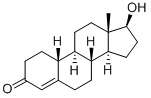
Anabolic androgenic steroids (AASs) are a large group of synthetic derivatives of the male gonadal hormone testosterone, which have both androgenic and anabolic effects. Based on replacement of the base molecule, AASs are classified in 3 main classes. Esterification at C-17 is related to class I. Class II is related to a demethylated group at C-19 and may also have C-17 esters. Alkylation at C-17 creates class III. Nandrolone (19-nortestosterone,17b-hydroxy-estr-4-en-3-one) belongs to the second class of AASs .The classification of AASs is presented in Fig. 1. Nandrolone usually used as esters, such as Nandrolone Decanoate (ND) and Nandrolone Phenylpropionate (NPP). The most commonly used esters are ND and to a lesser extent NPP.[1]

Brief History of Nandrolone
The anabolic-androgenic steroid, nandrolone, was synthesized in the early 1950s. Nandrolone is structurally very like testosterone. Only the methyl group in the 19 position is missing;consequently, nandrolone is also called nortestosterone or 19-nortestosterone.The metabolism of nandrolone was studied soon after and its phase I metabolism largely follows the metabolism of testosterone, with oxidation of the hydroxyl group in the 17 position (catalysed by 17b-hydroxysteroiddehydrogenase) forming a 17-oxo-steroid and complete reduction of the A-ring,i.e. the double bond in the 4 position (5a- and 5b-reductase, respectively) and the3-keto function are hydrogenated. As a result of this, the two main phase metabolites,NA (5a-isomer) and NE (5b-isomer) are formed. Both metabolites are mainly excreted as glucuronic acid conjugates. The structure of the main phase I metabolites was confirmed with the help of synthesis in 1960 and is described in a number of publications. NA and NE have also proved to be the main phase I metabolites of nandrolone-related steroids like norandrostenedione(estr-4-ene-3,17-dione) and norandrostenediol (estr-4-ene-3b,17b-diol). 3b-Hydroxy-isomers (3b-hydroxy-5a/b-estran-17-one, i.e. norepiandrosterone and norepietiocholanolone) are also excreted, but only as sulphates. The metabolism of nandrolone andnandrolone-related steroids is illustrated in Fig. 2.[2]

Nandrolone impairs myocardial proteome profile of rats
Dantas et al. aimed to investigate the effects of high doses of nandrolone decanoate and resistance training (RT) on the proteomic profile of the left ventricle (LV) of rats, using a label-free quantitative approach. Male rats were randomized into four groups: untrained vehicle (UTV), trained vehicle (TV), untrained nandrolone (UTN), and trained nandrolone (TN). Rats were familiarized with the exercise training protocol (jump exercise) for one week. Jump-exercise was performed five days a week for 6 weeks, with 30 s of inter-set rest intervals. Nandrolone was administrated for 6 weeks (5 mg/kg, twice a week, via intramuscular). Systolic and diastolic arterial pressure and heart rate were measured 48 h post-training. LV was isolated and collagen content was measured. The expression of cardiac proteins was analyzed by ultra-efficiency liquid chromatography with mass spectrometry high / low collision energy (UPLC/MS E). Nandrolone and RT led to cardiac hypertrophy, even though high doses of nandrolone counteracted the RT-induced arterial pressures lowering. Nandrolone also affected the proteome profile negatively in LV of rats, including critical proteins related to biological processes (metabolism, oxidative stress, inflammation), structural function and membrane transporters. Our findings show physiological relevance since high doses of nandrolone induced detrimental effects on the proteome profile of heart tissue and hemodynamic parameters of rats. Furthermore, as nandrolone abuse has become increasingly common among recreational athletes and casual fitness enthusiasts, Dantas et al. consider that our findings have clinical relevance as well.[3]
Effect of nandrolone on spatial localization and synaptic plasticity
Nandrolone is the most popular compound that are mainly abused. Experimental studies have reported that administration of nandrolone affects cognitive performance. So, the aim of this study is to evaluate the effect of nandrolone on spatial localization and synaptic plasticity of male adolescent rats. Experimantal groups received DMSO and nandrolone (10, 30 and 60 μg, i.c.v.). Another aim is to evaluate the role of castration on spatial learning and memory changes induced by nandrolone. Therefore, the rats of fifth and sixth groups were castrated and received DMSO or nandrolone. Analysis showed that escape latency and traveled distance in the group which received nandrolone (60 μg) were significantly lower than control group. Also, the escape latency and traveled distance in the group of castration which received nandrolone was significantly higher than nandrolone treated group. The results of field potential recording showed that fEPSP-LTP in nandrolone-treated group was higher than DMSO-treated group. The magnitude of fEPSP-LTP in the group of castration which received nandrolone was significantly lower than nandrolone-treated group. The results demonstrated that nandrolone improved spatial learning, but castration could abolished nandrolone-induced spatial learning improvement. These results indicating that at least some effect of nandrolone on learning induced through changes in gonadal function.[4]
Conclusion
Even though the use of Nandrolone for medical purposes is relatively safe, it can be harmful to health and cause side effects if used improperly. Many studies have confirmed the side effects of Nandrolone abuseon the liver, kidney, cardiovascular, reproductive, musculoskeletal andendocrine systems. In addition to the general adverse effects of Nandrolone, on sexual functions, a large number of experiments have reported that administration of Nandrolone has an adverse effect onbehavioral and cognitive functions. Nandrolone can change spatial ability, avoidance memory and hippocampal synaptic plasticity. Also, Nandrolone exposure produces variable effects on behavioral function such as aggression, depression and anxiety. This despite the fact that the results are contradictory. These discrepancies might be due to the differences in sex, age, dosage and treatment duration, and administration route. However, the negative results are more common than the published positive ones.[1-2]
References
[1] Niromand E, Javanmardy S, Salimi Z, Zarei F, Khazaei MR. Association between nandrolone and behavioral alterations: A systematic review of preclinical studies. Steroids. 2021;174:108901. doi:10.1016/j.steroids.2021.108901
[2] Hemmersbach P, Grosse J. Nandrolone: a multi-faceted doping agent. Handb Exp Pharmacol. 2010;(195):127-154. doi:10.1007/978-3-540-79088-4_6
[3] Dantas PS, Guzzoni V, Perez JD, et al. Nandrolone combined with strenuous resistance training impairs myocardial proteome profile of rats. Steroids. 2021;175:108916. doi:10.1016/j.steroids.2021.108916
[4] Salimi Z, Khajehpour L, Moradpour F, Moazedi AA, Pourmotabbed A, Zarei F. Nandrolone improve synaptic plasticity at the hippocampus CA1 area and spatial localization in the Morris water maze of male adolescent rats. Neurosci Res. 2020;158:21-29. doi:10.1016/j.neures.2019.09.001
See also

Lastest Price from Nandrolone manufacturers

US $1200.00/kg2025-11-24
- CAS:
- 434-22-0
- Min. Order:
- 1kg
- Purity:
- 99
- Supply Ability:
- 999

US $10.00/box2025-08-04
- CAS:
- 434-22-0
- Min. Order:
- 1box
- Purity:
- 99.99%
- Supply Ability:
- 9999